The Equation of Every Swirl: the Navier–Stokes equations, turbulence, Van Gogh's sky and a million-dollar question
The Equation of Every Swirl is five chapters about the Navier–Stokes equations, the mathematics behind every swirl of water and air. Each chapter is a live solution of a flowing fluid, with River, the narrator, explaining what you are seeing, and you can touch the water to stir it.
It starts with ink in still water, finds the hidden order in turbulence, discovers the same order in the sky of Van Gogh's The Starry Night and watches two smoke rings stretch each other. It ends on a million-dollar question about the equations themselves: whether they can ever break down.
At a glance
- Chapters
- 5, each a live simulation
- Length
- about 5 minutes played straight through
- Narrator
- River, with subtitles
- Free or Plus
- Free: chapters I–II. Everdust Plus: chapters III–V
- Where
- Everdust on Android now, and coming to iPhone, iPad and Apple Vision Pro
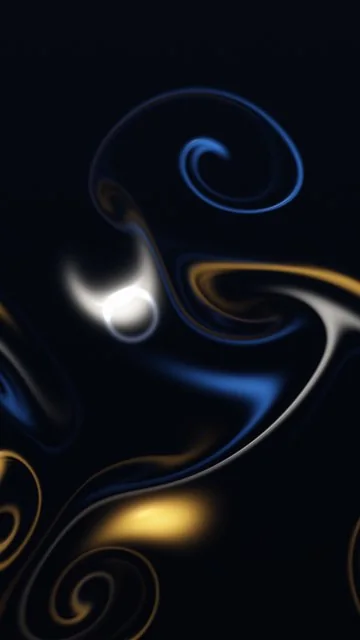 IInk in Water
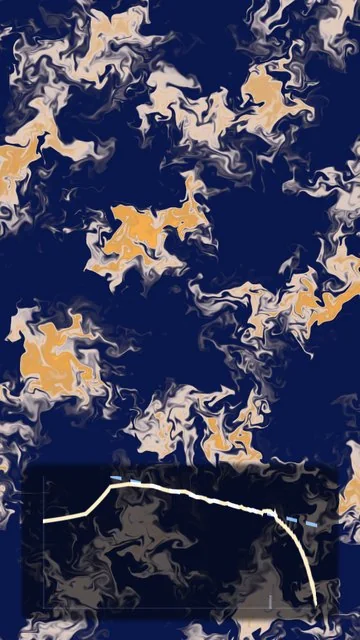 IIBig Whirls, Little Whirls
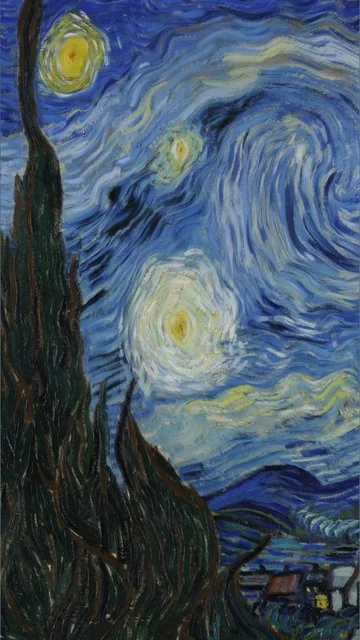 IIIVan Gogh's Sky
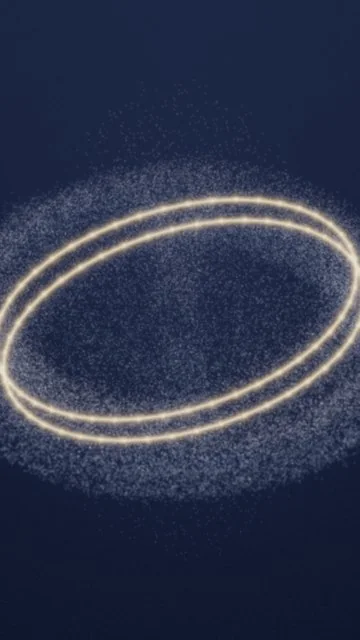 IVCan a Swirl Spin Up Without Limit?
 VThe Million-Dollar Question
Chapter by chapter
Chapter I Ink in Water Free
The Navier–Stokes equations solved live: ink in still water, then a stir.
Drops of blue, amber and violet ink appear in still water. Then a slow stir loops through them, and the ink rolls into swirls that turn, stretch and slowly calm. This is a thin, flat sheet of water, solved live as you watch; touch it to stir it yourself.
The same law governs ink in a glass and the clouds of Jupiter: the Navier–Stokes equations, named for Claude-Louis Navier and George Stokes and written down in the 19th century [1][2]. Stir the water and they say where every bit of it goes next. They weigh three things: how the moving water carries its own motion along, the pressure and forces that push it, and its internal friction, called viscosity [3]. They hold for water, air, blood and any ordinary fluid that can be treated as smooth and continuous rather than as separate molecules, which is why weather, the sea and the air over a wing all follow them [3]. Every swirl you have seen in water or air is one of their answers.
Chapter II Big Whirls, Little Whirls Free
Turbulence on a flat sheet, and the energy in each size of whirl, measured live.
One ink, marbled by turbulence, traces whirls inside whirls across a flat sheet of water. Below it, a bright line shows the energy in each size of whirl, big whirls on the left and small ones on the right, with a dashed line beside it for comparison. The chart is measured live from the flow.
In 1922 Lewis Fry Richardson summed up turbulence in a rhyme: big whirls have little whirls that feed on their velocity, and little whirls have lesser whirls, and so on to viscosity [4]. In 1941 Andrey Kolmogorov turned the idea into a law for three-dimensional turbulence [5]; in its usual form, the energy in each size of whirl falls along a slope of minus five-thirds, the dashed line [6]. On a flat sheet, energy climbs the other way, from small swirls into big ones, yet nearly the same slope appears, as Robert Kraichnan predicted in 1967 [7][8].
Chapter III Van Gogh's Sky Plus
The Starry Night, its sky moving the way real turbulence moves.
Vincent van Gogh's The Starry Night, and its sky begins to move. The flow turns around each star, the moon and the two great whirls while the village stays calm, and the view drifts from the great whirl to the cypress and the moon before pulling back to show the whole painting.
Van Gogh painted The Starry Night in 1889 at Saint-Rémy-de-Provence [9]. In 2024 a team of physicists measured how the painting's brightness varies across its whirls, from the biggest to the smallest, and found a minus five-thirds law: the counterpart of Kolmogorov's 1941 law for anything carried along by turbulence, published 52 years after the painting [10]. Their conclusion was that van Gogh had a very careful observation of real flows. A painting can't move, so the match is in its patterns, not in any motion; the movement in the chapter is a real flow steered toward the painting's own whirls.
Chapter IV Can a Swirl Spin Up Without Limit? Plus
Two smoke rings meet head on, and each is stretched.
Two smoke rings fly at each other and meet head on, and each is stretched wider. Smoke tracers ride the flow, and each ring's core glows in the color of how far it has been stretched, which is how much faster it spins: blue as fired, then white, then amber. Swipe to puff rings of your own.
In three dimensions a swirl can do something it can't on a flat sheet. Stretched along its axis, its core thins and spins faster, like a skater pulling in her arms [3]. Real vortex rings that collide head on widen, become unstable and can reconnect into smaller rings [11]. Flat flows can't stretch, and they are proved to stay smooth forever; in three dimensions, that is the question the prize asks [12]. Could stretching ever make a swirl spin infinitely fast in a finite time? If so, the equations would break down there, in what mathematicians call a blow-up. The chapter's rings illustrate stretching; they don't answer the question.
Chapter V The Million-Dollar Question Plus
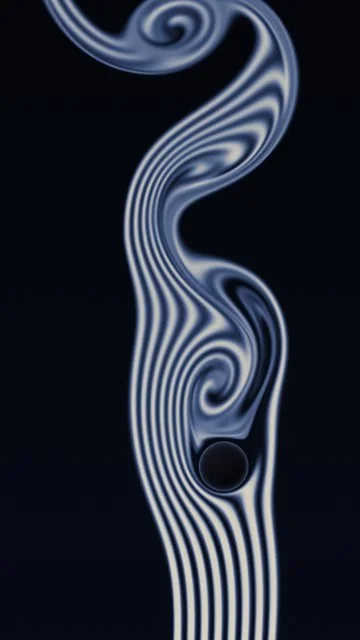
Wind past a post sheds a street of whirls, and the Clay Mathematics Institute's million-dollar question.
Wind blows past a post and sheds whirls, first from one side, then the other, into a long wavy street of swirls traced by smoke. Left alone, the post slides a little to one side and back; drag it yourself, and the air always knows what to do.
This is a von Kármán vortex street, which forms in the wake of a cylinder over a range of moderate flow speeds [13]. The same streets form in clouds behind islands, seen from space; one trailed for more than 300 kilometers south of Jan Mayen in the Arctic Ocean [14]. In 2000 the Clay Mathematics Institute named seven great unsolved problems and offered a million dollars for each [15]. One asks whether, in three dimensions, smooth starting flows always stay smooth under these equations for all time, or whether a smooth flow can blow up [12]. Of the seven, the Poincaré conjecture is the one the institute has so far recognized as solved [15].
What’s simulated, and what isn’t
Chapters I, II, III and V solve the Navier–Stokes equations live on a thin, flat sheet of water, and the energy chart in Chapter II is measured from that flow as it runs. Chapter IV follows two smoke rings in three dimensions, simplified to their thin spinning cores. Some things are drawn for you: the rings' glowing colors measure their stretch, the painting's flow is steered toward its own whirls while its village is held calm, and the inks are dyes carried by the water. Nothing here answers the prize question; the narration describes it only as the Clay Mathematics Institute states it.
Watch The Equation of Every Swirl in Everdust
The Equation of Every Swirl is in the Everdust app on Android now, and coming to iPhone, iPad and Apple Vision Pro. Open Everdust, choose Stories, then The Equation of Every Swirl. Free: chapters I–II. Everdust Plus: chapters III–V.
Everdust on Google Play (Android)
Everdust is free to download, with no ads and no account. Everdust Plus, an optional subscription, opens every chapter of every Story on Android.
Questions people ask
What are the Navier–Stokes equations? The equations that describe how ordinary fluids such as water and air move, balancing the fluid's own motion, the pressure and forces on it, and its internal friction [3].
What is the Navier–Stokes Millennium Prize problem? One of seven problems the Clay Mathematics Institute named in 2000, each with a $1 million prize: prove that smooth three-dimensional flows stay smooth for all time, or show one that breaks down [15][12].
Does The Starry Night really show turbulence? A 2024 study found that the brightness of its whirls follows the same minus five-thirds scaling as real turbulence. The match is statistical, since a painting has no motion [10].
Sources
- Clay Mathematics Institute. Navier-Stokes Equation (Millennium Prize Problems).
- Stokes, G. G. (2009). On the theories of the internal friction of fluids in motion, and of the equilibrium and motion of elastic solids. In Mathematical and Physical Papers, vol. 1, 75. Cambridge University Press (first published 1845).
- Batchelor, G. K. (2000). An Introduction to Fluid Dynamics. Cambridge University Press (first published 1967).
- Richardson, L. F. (2007). Weather Prediction by Numerical Process. Cambridge University Press (first published 1922).
- Kolmogorov, A. N. (1991). The local structure of turbulence in incompressible viscous fluid for very large Reynolds numbers. Proceedings of the Royal Society of London A 434, 9 (English translation of the 1941 paper).
- Frisch, U. (1995). Turbulence: The Legacy of A. N. Kolmogorov. Cambridge University Press.
- Kraichnan, R. H. (1967). Inertial ranges in two-dimensional turbulence. The Physics of Fluids 10, 1417.
- Boffetta, G. & Ecke, R. E. (2012). Two-dimensional turbulence. Annual Review of Fluid Mechanics 44, 427.
- The Museum of Modern Art, New York. Vincent van Gogh, The Starry Night (1889), on Google Arts & Culture.
- Ma, Y., Cheng, W., Huang, S., Schmitt, F. G., Lin, X. & Huang, Y. (2024). Hidden turbulence in van Gogh's The Starry Night. Physics of Fluids 36, 095140.
- Lim, T. T. & Nickels, T. B. (1992). Instability and reconnection in the head-on collision of two vortex rings. Nature 357, 225.
- Fefferman, C. L. Existence and smoothness of the Navier-Stokes equation. Official problem description, Clay Mathematics Institute.
- Williamson, C. H. K. (1996). Vortex dynamics in the cylinder wake. Annual Review of Fluid Mechanics 28, 477.
- NASA Earth Observatory. A Vortex Street in the Arctic (Jan Mayen, MISR).
- Clay Mathematics Institute. The Millennium Prize Problems.
The Starry Night (1889) by Vincent van Gogh, The Museum of Modern Art, New York: a public-domain photographic reproduction. Chapter stills: Everdust, from each chapter’s live simulation. The Story’s script was written for Everdust from the sources above; River reads it. This page retells it in its own words.
More Stories
The Secret Life of Fluids
A soap bubble's skin, rain on a window, the sea and Jupiter's storms: the same rules at every scale.
Clockwork to Chaos
Three hundred years of perfect clockwork, undone by one more hinge.
Chaos: The Attractor We Found
From Lorenz's rounding error to a strange attractor our own search turned up.
Hidden Patterns
Fireflies, starlings, sand, magnets and light, each making a pattern no one designed.