Stephan's Quintet
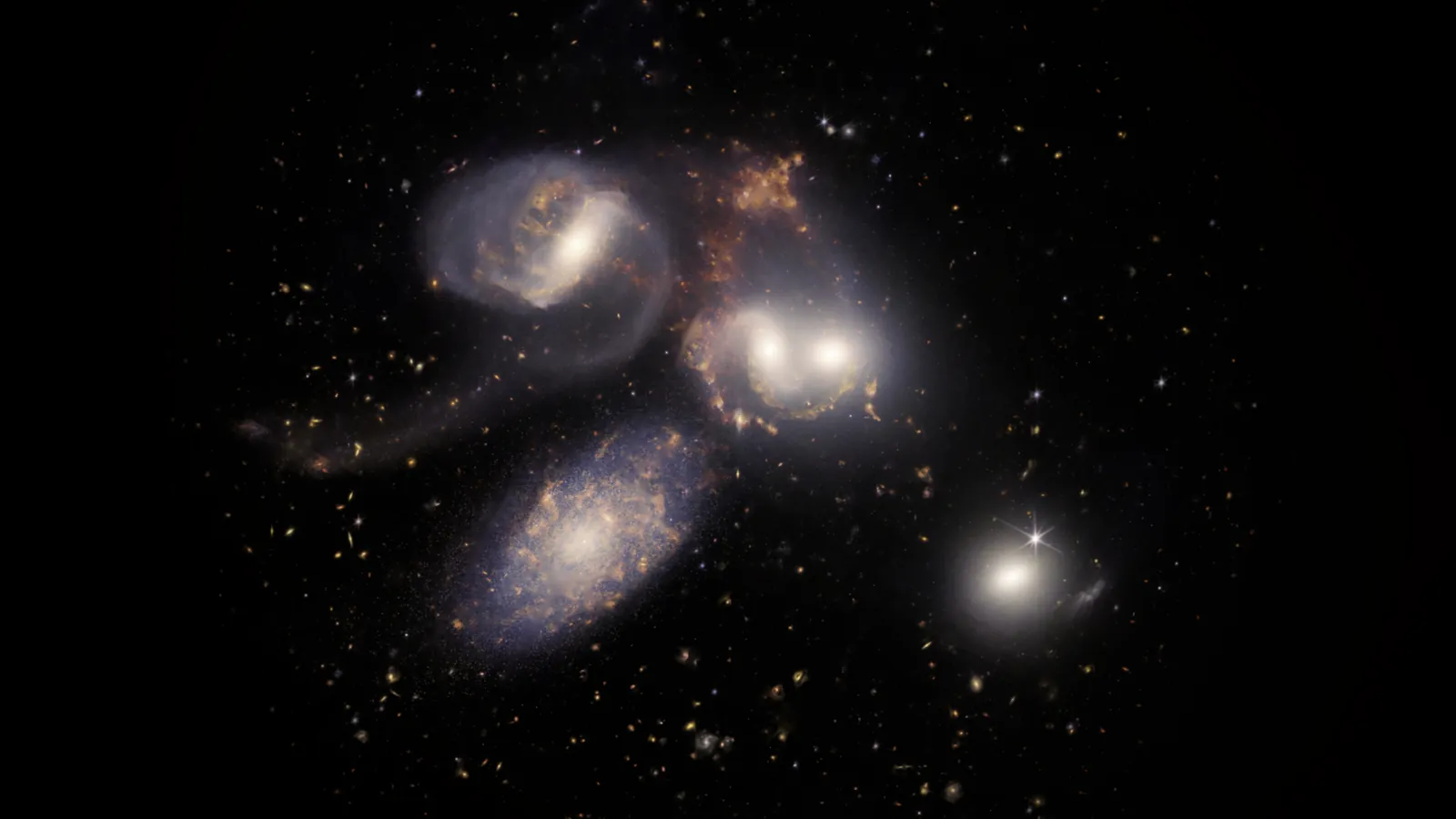
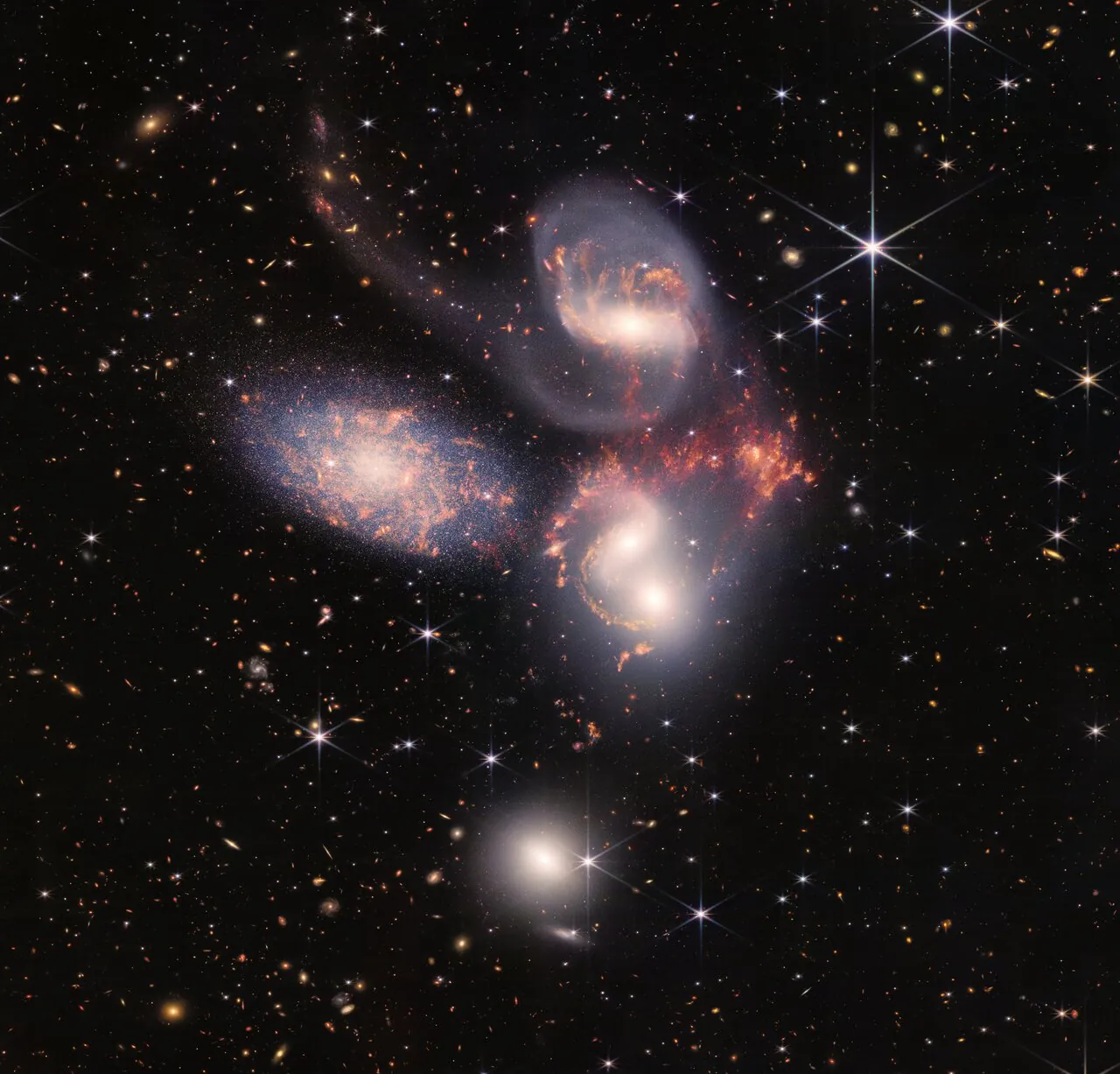
Stephan's Quintet is a tight group of five galaxies in Pegasus, but only four of them belong together. Those four, about 290 million light-years away, are pulling at each other and colliding, setting off shock waves and bursts of new stars. The fifth, NGC 7320, is only about 40 million light-years away, far in front. You need a large telescope to see them at all.
When to see it
Best evenings: August to December (northern hemisphere).
Seen from north of about 46° S. Choose your city for tonight’s times and where to look.
“Up” means at least 10° above the horizon while the Sun is at least 12° below it (dark enough for faint nebulae and galaxies). Your location, if you share it, stays on this device.
At a glance
- Distance
- 290 million light-years [1]
- The light you see left it
- 290 million years ago
- Constellation
- Pegasus
- Position (J2000)
- RA 22h 35m 57s, Dec +33° 58′
- Visible from
- north of about 46° S (farther south it never climbs 10° above the horizon)
- High in the evening (9 pm)
- August to December from mid-northern latitudes
- How to see it
- With a large telescope or a camera
Stephan's Quintet tonight from four cities
| City | Tonight |
|---|---|
| New York | Up now until 2:30 am, best around 11:30 pm, look west.best 11:30 pm, 41° up, west |
| Los Angeles | Up now until 2 am, best around 8:30 pm, look almost straight up.best 8:30 pm, 75° up, overhead |
| London | Not visible from here tonight; best in September.not tonight; best in September |
| Sydney | Up after dark until 11:20 pm, best around 8:30 pm, look north.best 8:30 pm, 22° up, north |
Tonight in each city’s local time, computed November 8, 2026 with Astronomy Engine (the page refreshes every hour). For your own city, choose it above.
Stephan's Quintet: the facts
| Also called | Hickson Compact Group 92 (HCG 92) [2] |
|---|---|
| The four colliding galaxies | NGC 7317, NGC 7318A, NGC 7318B and NGC 7319 [1] |
| The fifth, in front | NGC 7320, about 40 million light-years away [2] |
| Webb's mosaic covers | about a fifth of the Moon's width, from almost 1,000 image files [1] |
| In the center of NGC 7319 | an actively feeding supermassive black hole [2] |
What is happening in Stephan's Quintet?
One galaxy, NGC 7318B, is smashing through the group, and the collision drives a huge shock wave through the gas between the galaxies, which Webb's mid-infrared camera shows in red and gold. Tails of gas, dust and stars are being pulled out of several galaxies, and the disturbances set off clusters of new stars.
Tight groups like this may have been more common in the early Universe, so astronomers use the Quintet as a nearby laboratory for how galaxies grow by merging.
Step inside Stephan's Quintet in Everdust
In Everdust’s Night Sky, look at Stephan's Quintet and pinch to fly there on Apple Vision Pro, or tap it on iPhone, iPad and Android. What you arrive in, in the app’s own words: “Stephan's Quintet as it is today: Webb's photograph of it, the nearer galaxy in front of the four colliding ones.”
Everdust on the App Store for iPhone, iPad and Vision ProEverdust on Google Play for Android
Everdust is free on the App Store for Apple Vision Pro, iPhone and iPad, and on Google Play for Android; Night Sky flies to Stephan's Quintet on all of them. It is also free on Apple TV, with other worlds. I make Everdust, so weigh that; a star-map app such as Stellarium or SkySafari will find Stephan's Quintet just as well.
Questions people ask
Can I see Stephan's Quintet tonight? It depends on where you are. It can be seen from north of about 46° S, and it is best in the evening sky August to December from mid-northern latitudes. Choose your city on this page for tonight's times and where to look. With a large telescope or a camera: Faint: a large amateur telescope under a dark sky shows them as small smudges.
Where is Stephan's Quintet in the sky? In the constellation Pegasus, at right ascension 22h 35m 57s and declination +33° 58′ (J2000). It can be seen from north of about 46° S (farther south it never climbs 10° above the horizon).
Why is it called a quintet if only four galaxies are together? It was named for the five galaxies that appear together on the sky. Only four are truly close; NGC 7320, the one at lower left in Webb's image, is about 40 million light-years away, much nearer than the others' 290 million (ESA/Webb).
Is Stephan's Quintet in a famous film? Yes: it appears in the opening of the 1946 film It's a Wonderful Life (ESA/Webb).
Sources
- Distance: “the other four galaxies (NGC 7317, NGC 7318A, NGC 7318B, and NGC 7319) are about 290 million light-years away” (esawebb.org, the figure Everdust uses)
- ESA/Webb weic2208a: Stephan’s Quintet (NIRCam + MIRI Imaging)
Distance and position: the deep-sky catalog in Everdust’s Night Sky (read November 1, 2026), each figure quoted from the source above. Constellation, seasons and tonight are computed with Astronomy Engine (Don Cross, MIT license). More: Wikipedia.