Why do fireflies flash in sync? The science of synchronous fireflies
Fireflies flash in sync because each male nudges the timing of his flashes toward the flashes he sees around him. No firefly leads; small local adjustments spread until a whole tree, or a whole hillside, blinks as one. Synchrony is the exception among fireflies, and the best-known displays are in the mangrove rivers of Southeast Asia and in the Great Smoky Mountains of the United States.
Where fireflies flash together
In Thailand and Malaysia, males of Pteroptyx fireflies gather in trees along tidal rivers and flash in unison, tree after tree [1]. When John and Elisabeth Buck filmed Pteroptyx malaccae in Thailand in the 1960s, the males flashed about once every 0.56 seconds, and their flashes coincided to within about 20 thousandths of a second [2].
In North America the famous display belongs to Photinus carolinus in Great Smoky Mountains National Park, which is home to 19 firefly species. Its males give five to eight distinct flashes, then go dark for about eight seconds, and repeat. The mating season lasts two to three weeks a year, and since 1993 the peak has fallen between the third week of May and the third week of June [3]. Lynn Faust's long study of the species in the park described its natural history and flash patterns in detail [4].
How each firefly keeps time
Each firefly has its own internal rhythm, like a clock that counts down to its next flash. Seeing other flashes changes that countdown. In Pteroptyx the flashes line up more tightly than the time a firefly would need to see a flash and react to it, so the Bucks concluded the insects anticipate the beat from earlier cycles, much as people keep time to music, rather than simply copying each flash [2]. Later models of the same species let each firefly adapt the speed of its own clock to the rhythm around it [5].
The mathematics: clocks that nudge each other
In 1990 the mathematicians Renato Mirollo and Steven Strogatz studied a population of identical clocks, each of which fires when it reaches a threshold and then resets. Whenever one fires, it pulls the others a fixed step closer to firing. They proved that, from almost any starting state, the whole population ends up firing in unison [6]. Once two clocks fire together they stay together, so the groups in step only grow.
Their model grew out of one Charles Peskin had made in 1975 for the pacemaker cells of the heart, and they pointed to fireflies, crickets chirping in unison and pacemaker cells as real examples [6]. The same idea, local nudges with no conductor, now appears across physics and biology.
What happens inside a real swarm
Real swarms are messier than the math. Filming Photinus carolinus in three dimensions with 360-degree cameras, Raphaël Sarfati, Julie Hayes and Orit Peleg found that at low density the flashes look uncorrelated, while at high density the swarm makes synchronous flashes in periodic bursts [7]. Even a few males try to flash together, but the regular bursts appear only in groups of more than about 15 [8].
Within a burst the synchronous flashes come about every half second, and bursts repeat roughly every 12 seconds. A burst starts with a few flashers and spreads across the swarm in a relay, like a wave, at about half a meter per second, shaped by what each firefly can see past the trees and plants around it [7].
Why flash together?
Synchrony seems to help the males be recognized. In experiments with Photinus carolinus, females were more likely to answer simulated male flashes that were synchronized than ones that were not, which suggests flashing in unison cuts the visual clutter so a female can pick out her own species' pattern [9]. The National Park Service notes that the behavior is still not fully understood [3].
The same rule in your heart
Your heartbeat starts in the sinus node, a cluster of thousands of pacemaker cells that could each set a rhythm on its own. A 1987 model showed how they fall into a single beat through mutual nudges, a "democratic" process, rather than by following one leader cell [10]. It is the fireflies' trick, in a few millimeters of tissue.
Watch it in Everdust
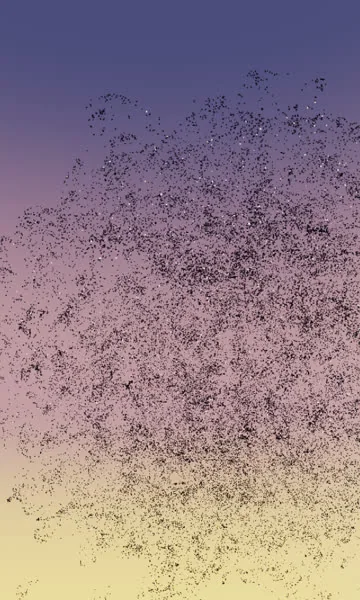
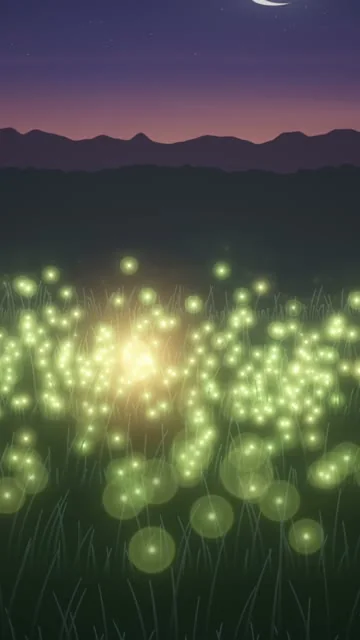
Fireflies in Step is Chapter I of Hidden Patterns. Hundreds of fireflies fill a dusk meadow, each a clock that hurries a little when it sees a neighbor flash, seen with a short delay so order spreads as ripples. Within about twenty seconds the meadow flashes as one. Hold a finger down to hang a lantern and the fireflies around it fall in step with it, then the rest. It is the Mirollo–Strogatz kind of rule at work, not a recording of real fireflies.
Watch it in Everdust
Hidden Patterns is in the Everdust app on iPhone and iPad, Android, Apple Vision Pro, Mac, Apple TV and Meta Quest 3 and 3S. Open Everdust, choose Stories, then Hidden Patterns; Fireflies in Step is chapter 1. Free: all 7 chapters.
Everdust on the App Store (iPhone, iPad, Apple Vision Pro, Mac, Apple TV)Everdust on Google Play (Android)Everdust on the Meta Horizon Store (Quest 3 and 3S)
Everdust is free to download, with no ads and no account. Every chapter of Hidden Patterns is free on iPhone, iPad, Android, Apple Vision Pro, Mac and Apple TV (on Meta Quest, which chapters are free can differ).
The rest of the Story, chapter by chapter: Hidden Patterns.
Questions people ask
Where can I see synchronous fireflies in the US? The best-known display is Photinus carolinus in Great Smoky Mountains National Park. It lasts two to three weeks, with a peak that has fallen between the third week of May and the third week of June [3].
Do all fireflies flash in sync? No. Of the 19 firefly species in Great Smoky Mountains National Park, some don't flash at all and most of the rest use their own species' flash pattern to find each other; the park singles out Photinus carolinus as its synchronous firefly [3][11].
Is firefly synchrony like a heartbeat? Mathematically, yes. The model proved to synchronize grew out of a model of the heart's pacemaker cells, and those cells also keep time by nudging one another [6][10].
Sources
- Buck, J. (1988). Synchronous rhythmic flashing of fireflies. II. The Quarterly Review of Biology 63, 265.
- Buck, J. & Buck, E. (1968). Mechanism of rhythmic synchronous flashing of fireflies. Science 159, 1319.
- National Park Service, Great Smoky Mountains National Park. Synchronous Fireflies.
- Faust, L. F. (2010). Natural history and flash repertoire of the synchronous firefly Photinus carolinus (Coleoptera: Lampyridae) in the Great Smoky Mountains National Park. Florida Entomologist 93, 208.
- Ermentrout, B. (1991). An adaptive model for synchrony in the firefly Pteroptyx malaccae. Journal of Mathematical Biology 29, 571.
- Mirollo, R. E. & Strogatz, S. H. (1990). Synchronization of pulse-coupled biological oscillators. SIAM Journal on Applied Mathematics 50, 1645.
- Sarfati, R., Hayes, J. C. & Peleg, O. (2021). Self-organization in natural swarms of Photinus carolinus synchronous fireflies. Science Advances 7, eabg9259.
- Sarfati, R. et al. (2020). Spatio-temporal reconstruction of emergent flash synchronization in firefly swarms via stereoscopic 360-degree cameras. Journal of the Royal Society Interface 17, 20200179.
- Moiseff, A. & Copeland, J. (2010). Firefly synchrony: a behavioral strategy to minimize visual clutter. Science 329, 181.
- Michaels, D. C., Matyas, E. P. & Jalife, J. (1987). Mechanisms of sinoatrial pacemaker synchronization: a new hypothesis. Circulation Research 61, 704.
- National Park Service, Great Smoky Mountains National Park. Firefly Flash Patterns.