The Butterfly Nebula
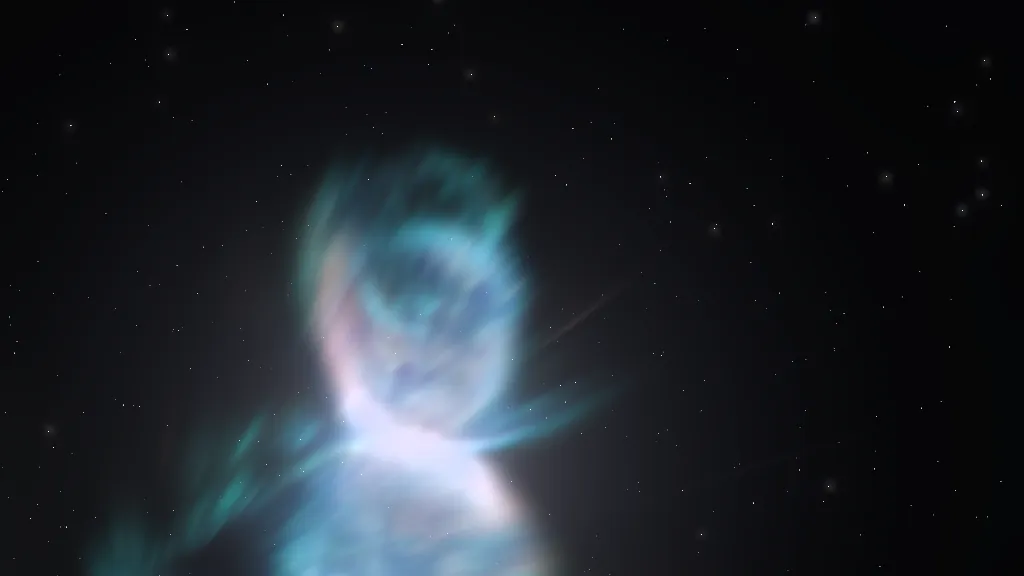
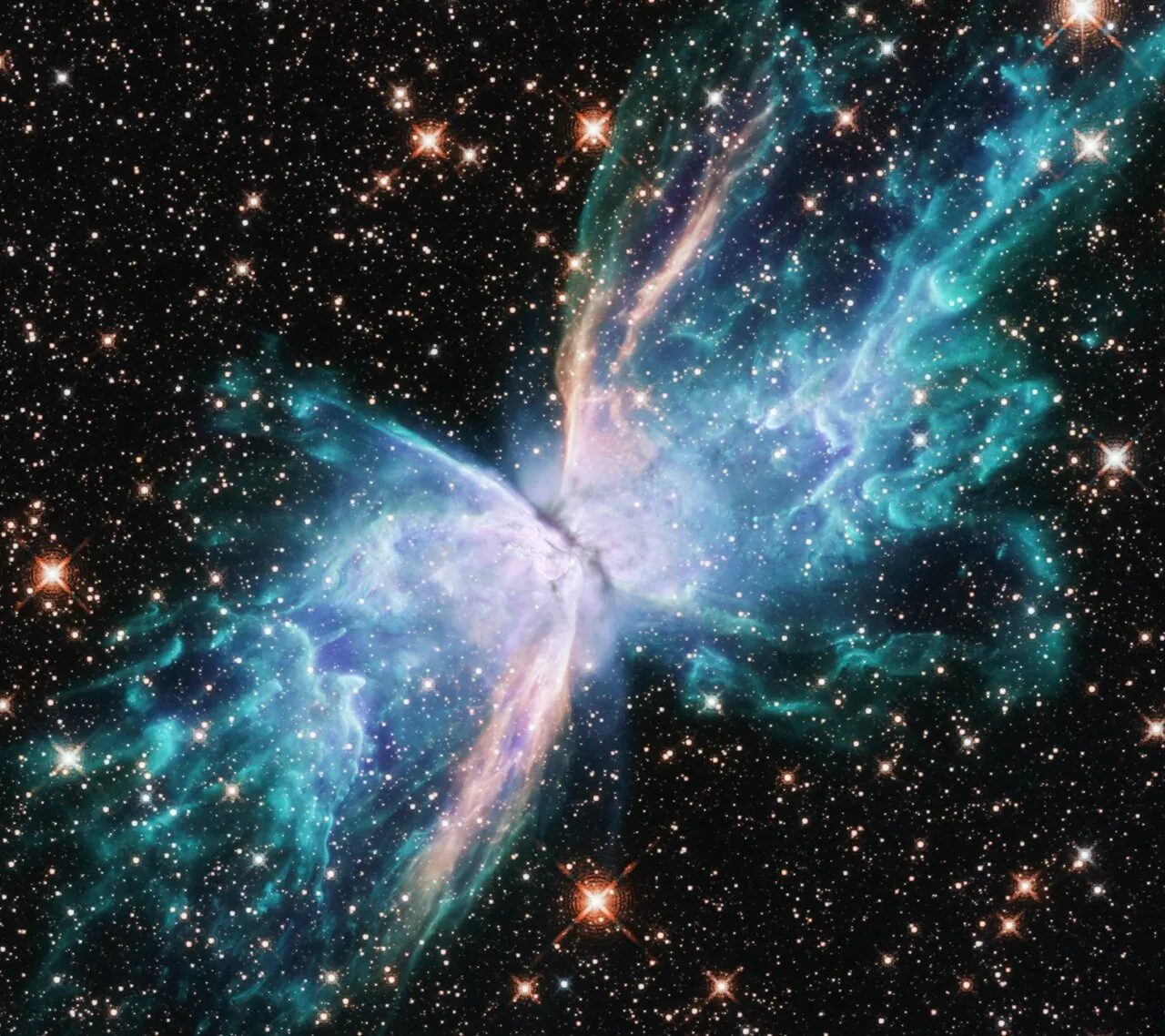
The Butterfly Nebula is a planetary nebula: the outer layers of a dying star, blown out in two opposite lobes that look like wings, about 3,400 light-years away in Scorpius. A thick ring of dust across its middle, the butterfly's body, hides the star at its center, the hot core of a star that was once like the Sun but heavier.
When to see it
Best evenings: May to October (southern hemisphere).
Seen from south of about 43° N. Choose your city for tonight’s times and where to look.
“Up” means at least 10° above the horizon while the Sun is at least 12° below it (dark enough for faint nebulae and galaxies). Your location, if you share it, stays on this device.
At a glance
- Distance
- 3,400 light-years [1]
- The light you see left it
- around 1,400 BCE
- Constellation
- Scorpius
- Position (J2000)
- RA 17h 13m 45s, Dec −37° 06′
- Visible from
- south of about 43° N (farther north it never climbs 10° above the horizon)
- High in the evening (9 pm)
- May to October from mid-southern latitudes
- How to see it
- With a small telescope
The Butterfly Nebula tonight from four cities
| City | Tonight |
|---|---|
| New York | Not visible from here tonight; best in June.not tonight; best in June |
| Los Angeles | Not visible from here tonight; best in June.not tonight; best in June |
| London | Only ever low on your horizon here; best in June.only ever low here |
| Sydney | Up after dark until 9:50 pm, best around 8:30 pm, look south-west.best 8:30 pm, 25° up, south-west |
Tonight in each city’s local time, computed November 8, 2026 with Astronomy Engine (the page refreshes every hour). For your own city, choose it above.
The Butterfly Nebula: the facts
| Also called | NGC 6302 [2] |
|---|---|
| Its wings | stretch more than two light-years, about half the distance from the Sun to Proxima Centauri [2] |
| How long it took | the gas was expelled over about 2,200 years [2] |
| Its body | a doughnut-shaped torus of dust seen from the side, hiding the central star [1] |
How did the Butterfly Nebula get its shape?
Stars between about 0.8 and 8 times the Sun's mass shed most of their mass at the end of their lives. In the Butterfly, a dense ring of dust round the star's waist stopped the gas from flowing out equally in every direction, so it escaped in two opposite lobes: a bipolar nebula. Hubble's observations show the jets and gas bubbles blasting off the star changing fast and in great complexity.
The planetary nebula stage is short: about 20,000 years, a blink in a star's life.
Step inside the Butterfly Nebula in Everdust
In Everdust’s Night Sky, look at the Butterfly Nebula and pinch to fly there on Apple Vision Pro, or tap it on iPhone and iPad. What you arrive in, in the app’s own words: “The Butterfly Nebula as it is today. Its own slider replays how the dying star made it.”
Everdust on the App Store for iPhone, iPad and Vision Pro
Everdust is free on the App Store for Apple Vision Pro, iPhone and iPad; Night Sky flies to the Butterfly Nebula on each. It is also free on Apple TV and on Google Play for Android, with other worlds; Android’s Night Sky has other wonders, not this one. I make Everdust, so weigh that; a star-map app such as Stellarium or SkySafari will find the Butterfly Nebula just as well.
Questions people ask
Can I see the Butterfly Nebula tonight? It depends on where you are. It can be seen from south of about 43° N, and it is best in the evening sky May to October from mid-southern latitudes. Choose your city on this page for tonight's times and where to look. With a small telescope: A small telescope shows a small, elongated glow; best from the Southern Hemisphere and low northern latitudes, where Scorpius rides high.
Where is the Butterfly Nebula in the sky? In the constellation Scorpius, at right ascension 17h 13m 45s and declination −37° 06′ (J2000). It can be seen from south of about 43° N (farther north it never climbs 10° above the horizon).
How far away is the Butterfly Nebula? About 3,400 light-years (ESA, 2025). Older sources, including Hubble's 2020 image page, give about 3,800.
Why can't you see the Butterfly Nebula's central star? It's hidden behind the dusty torus that forms the butterfly's body. Its light still powers the nebula's glow.
Sources
- Distance: “The Butterfly Nebula, located about 3400 light-years away” (esa.int, the figure Everdust uses)
- ESA/Hubble heic2011b: NGC 6302
Distance and position: the deep-sky catalog in Everdust’s Night Sky (read November 1, 2026), each figure quoted from the source above. Constellation, seasons and tonight are computed with Astronomy Engine (Don Cross, MIT license). More: Wikipedia.