Will the Sun swallow the Earth when it becomes a red giant?
Probably, but it is closer than you might think. In about five billion years the Sun will run out of hydrogen in its core and begin to swell into a red giant, and at its largest it may reach a little beyond Earth's present orbit. By then it will have lost so much mass that Earth's orbit will have widened, which could save it, but the tides Earth raises on the bloated Sun pull the other way. The most detailed model says the tides win and Earth is swallowed, though not every model agrees. Either way, Earth will have lost its oceans billions of years earlier.
When does the Sun become a red giant?
The Sun is about 4.6 billion years old and roughly halfway through its long, steady life of fusing hydrogen into helium in its core. In one detailed model it leaves that stage about 5.4 billion years from now. Its core, by then mostly helium, shrinks and heats while hydrogen burns in a shell around it, and the outer layers swell and cool. About 7.6 billion years from now the Sun reaches the top of this red-giant phase: 256 times its present radius, about 1.2 times the distance from Earth to the Sun today, some 2,700 times as bright as now, with a surface temperature of only about 2,600 kelvin [1].
Helium then ignites in the core, the giant shrinks, and later it swells again in a second giant phase before it sheds its outer layers. In that model the second swelling never gets as big as the first, so the first red-giant peak is the dangerous moment for Earth [1].
A lighter Sun loosens its grip
A red giant blows its outer layers away in a strong wind. By the top of the red-giant phase the Sun will have lost about a third of its mass, and as its pull weakens, the planets drift outward. If nothing else acted on it, Earth's orbit would widen to about 1.5 times its present size, comfortably outside the swollen Sun [1].
An earlier model, with somewhat less mass loss, found the Sun peaking at 170 times its present radius as a red giant and at 213 times, almost exactly Earth's present orbit, early in its second giant phase. By then Venus and Earth had moved out to 1.22 and 1.69 times their present distances, and both escaped. The same authors noted that a little less mass loss could mean Venus, or even Earth, is engulfed after all [2].
Tides pull the other way
Mass loss is not the whole story. A red giant spins very slowly, so the bulge that Earth's gravity raises on it lags behind and tugs Earth backward, draining its orbit, and near the giant's surface Earth would also plow through the star's thin outer atmosphere. When Klaus-Peter Schröder and Robert Smith followed these effects step by step through the red-giant peak, Earth could not escape. To survive, they found, a planet would need to orbit at least about 1.15 times Earth's present distance today [1].
So the honest answer is "probably". The result hangs on how fast the giant Sun loses mass and how strongly the tides act, and both are still uncertain.
Mercury, Venus and Mars
Mercury is swallowed in every one of these models, during the first red-giant phase [2][1]. Venus escapes only in the model in which Earth also escapes [2]; with tides included, it is lost too [1]. Mars orbits at about 1.5 times Earth's distance [3], outside the 1.15 limit, so it should survive and end up circling a white dwarf [1].
Earth's oceans are gone long before
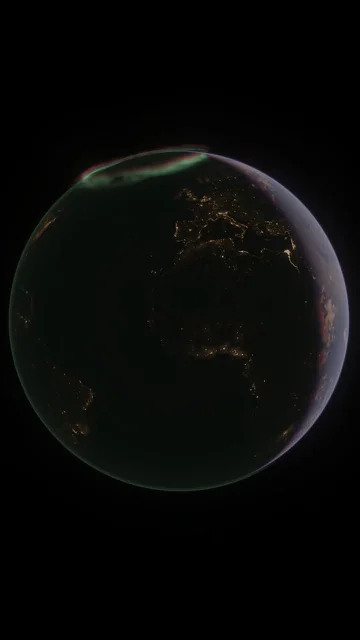
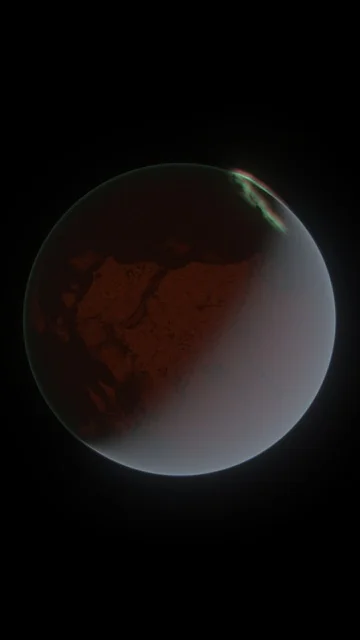
Earth's real deadline comes far sooner. The Sun is slowly brightening, by about 10 percent over the next billion years, and that alone should push Earth out of the zone where liquid water can last on its surface in about a billion years [1]. Climate models find that once sunlight is about 10 percent stronger than today, water vapor high in the air is split by sunlight and its hydrogen lost to space, and at about 40 percent stronger the oceans boil away completely in a runaway greenhouse [4]. The Sun reaches those levels in about 1.1 and 3.5 billion years [2]. By the time the red giant arrives, Earth would be a dry, scorched world.
We have seen it happen to other planets
In 2020 a sky survey caught a short outburst followed by a long infrared glow from a Sun-like star in our galaxy. Astronomers concluded the star had swallowed a planet of one to ten times Jupiter's mass, the first time a star has been seen in the act of engulfing a planet [5].
Survivors exist too. A planet of about 1.4 times Jupiter's mass circles a white dwarf at least 2.8 times as far out as Earth is from the Sun, evidence that worlds in Jupiter-like orbits can outlast their star's giant phases [6]. Calculations suggest no planet should be found closer than about 1.5 times Earth's distance around a white dwarf that started out like the Sun [7]. And between a quarter and a half of young white dwarfs show heavy elements in their atmospheres, thought to come from rocky bodies torn apart and falling onto them [8].
What is left of the Sun
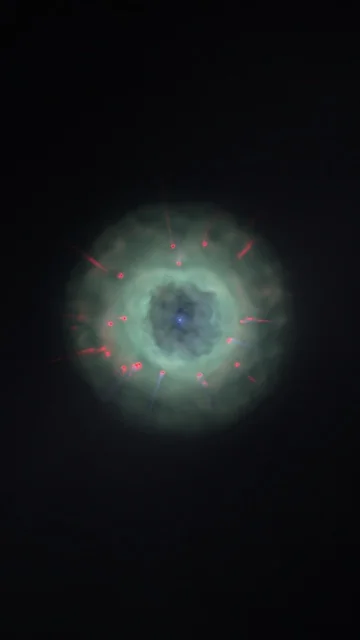
After its giant phases the Sun sheds what remains of its outer layers and leaves its core behind as a white dwarf of a little over half its present mass [2]. Whether the cast-off gas makes a glowing planetary nebula is debated: one model says the Sun will produce no regular nebula [1], while newer models of a dying star's last stages predict a faint one [9].
Watch it in Everdust
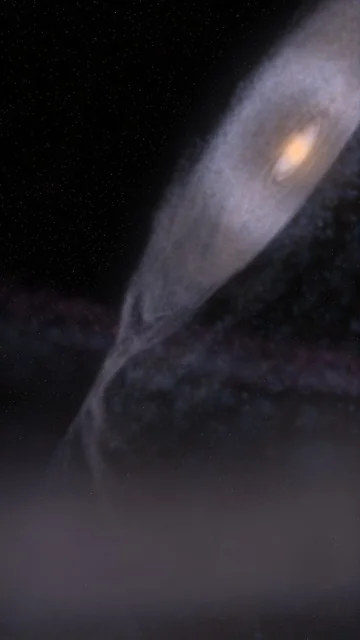
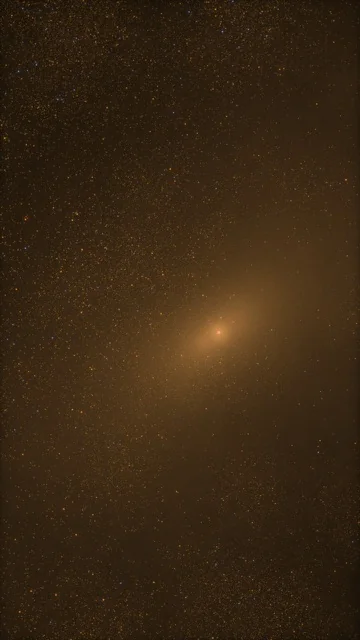
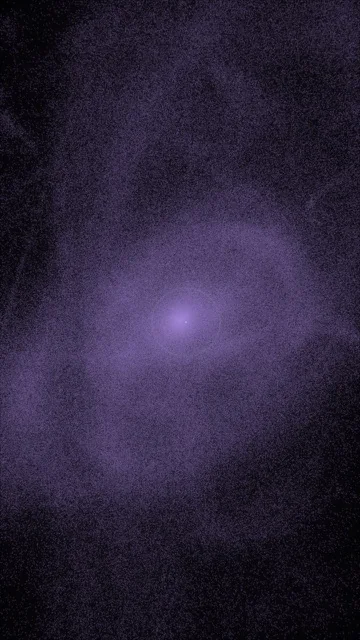
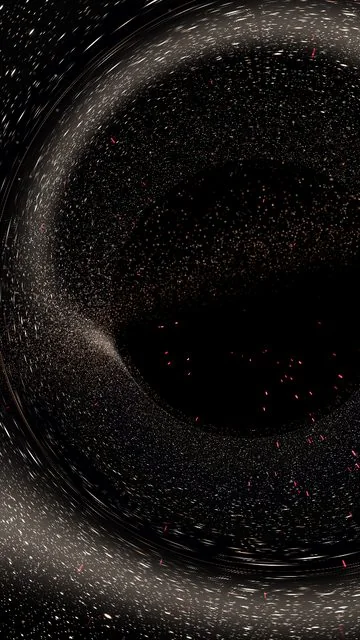
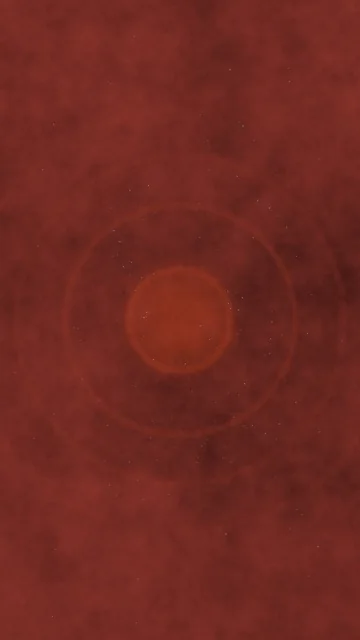
The Red Giant is Chapter IV of The Future of Everything. The Sun swells in front of you with a boiling surface while Mercury, Venus, Earth and Mars orbit it, and the planets' orbits are computed live as the Sun loses mass and raises tides on them. Mercury and Venus are swallowed, Earth follows and Mars survives. The narration says Earth "probably" follows, because that is as far as the science goes. The same scene is Chapter IV of The Life of a Star, which follows a star like the Sun from its birth to its last light.
Watch it in Everdust
The Future of Everything is in the Everdust app on iPhone and iPad, Android, Apple Vision Pro, Mac, Apple TV and Meta Quest 3 and 3S. Open Everdust, choose Stories, then The Future of Everything; The Red Giant is chapter 4. Free: chapters I–II. Everdust Plus: chapters III–IX.
Everdust on the App Store (iPhone, iPad, Apple Vision Pro, Mac, Apple TV)Everdust on Google Play (Android)Everdust on the Meta Horizon Store (Quest 3 and 3S)
Everdust is free to download, with no ads and no account. Everdust Plus, an optional subscription, opens every chapter of every Story on iPhone, iPad, Android, Apple Vision Pro, Mac and Apple TV (on Meta Quest, which chapters are free can differ).
The rest of the Story, chapter by chapter: The Future of Everything.
Questions people ask
When will the Sun become a red giant? It begins to swell in about 5 billion years and is at its largest about 7.6 billion years from now, in one detailed model [1].
Will Earth still be habitable when the Sun becomes a red giant? No. The brightening Sun should end liquid water on Earth's surface somewhere between about 1 and 3.5 billion years from now, long before the red giant [2][4].
Will Mars survive? Probably. Even the model that swallows Earth leaves planets that start beyond about 1.15 times Earth's distance outside the Sun, and Mars orbits at about 1.5 [1][3].
Sources
- Schröder, K.-P. & Smith, R. C. (2008). Distant future of the Sun and Earth revisited. Monthly Notices of the Royal Astronomical Society 386, 155.
- Sackmann, I.-J., Boothroyd, A. I. & Kraemer, K. E. (1993). Our Sun. III. Present and future. The Astrophysical Journal 418, 457.
- NASA Goddard Space Flight Center. Planetary Fact Sheet (NSSDCA).
- Kasting, J. F. (1988). Runaway and moist greenhouse atmospheres and the evolution of Earth and Venus. Icarus 74, 472.
- De, K. et al. (2023). An infrared transient from a star engulfing a planet. Nature 617, 55.
- Blackman, J. W. et al. (2021). A Jovian analogue orbiting a white dwarf star. Nature 598, 272.
- Mustill, A. J. & Villaver, E. (2012). Foretellings of Ragnarök: world-engulfing asymptotic giants and the inheritance of white dwarfs. The Astrophysical Journal 761, 121.
- Koester, D., Gänsicke, B. T. & Farihi, J. (2014). The frequency of planetary debris around young white dwarfs. Astronomy & Astrophysics 566, A34.
- Gesicki, K. et al. (2018). The mysterious age invariance of the planetary nebula luminosity function bright cut-off. Nature Astronomy 2, 580.