The Story of the Continents: four billion years of drifting land, from a world of water to the next Pangaea
The Story of the Continents follows Earth's land for four billion years in nine short chapters, each a globe you can turn and zoom while River, the narrator, tells you what you are looking at. It opens on a planet that is almost all ocean and ends 250 million years from now, with four possible shapes for the next supercontinent.
Its thread is the supercontinent cycle: every few hundred million years nearly all the land gathers into one mass, then tears apart again [1]. You watch the oldest surviving crust, the forgotten supercontinents Nuna and Rodinia, a planet frozen from pole to pole, the rise and breakup of Pangaea, the asteroid that ended the dinosaurs and the Atlantic still widening today. Where scientists disagree, the Story says which way it leans and why.
At a glance
- Chapters
- 9, each a live simulation
- Length
- about 9 minutes played straight through
- Narrator
- River, with subtitles
- Free or Plus
- Free: chapters I–IV. Everdust Plus: chapters V–IX
- Where
- Everdust on Android now, and coming to iPhone, iPad and Apple Vision Pro
 IOne after another
 IIA world of water
 IIIThe first survivors
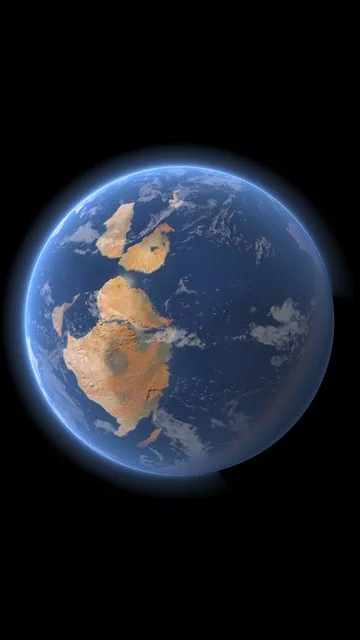 IVNuna and the boring billion
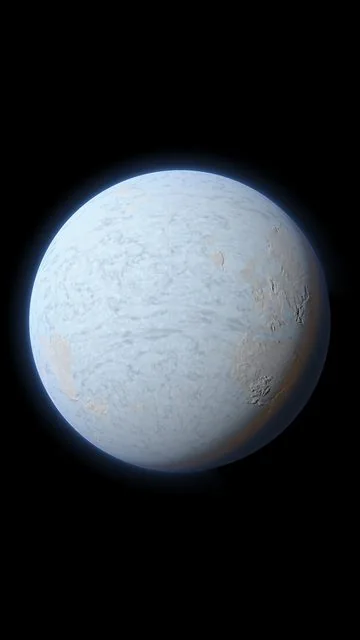 VRodinia and Snowball Earth
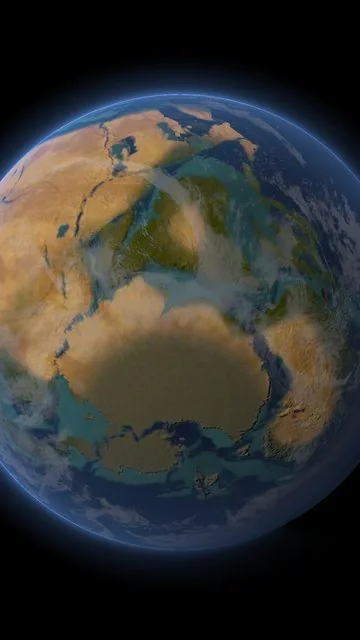 VIPangaea
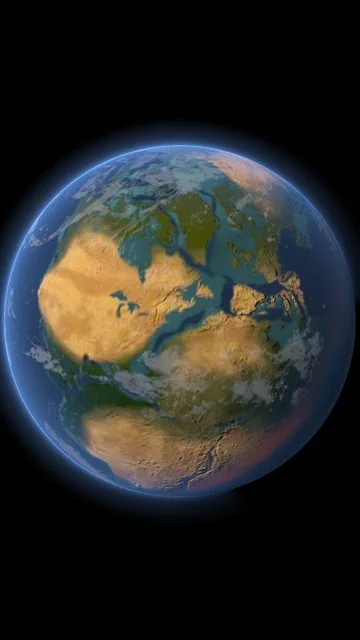 VIIBreaking apart
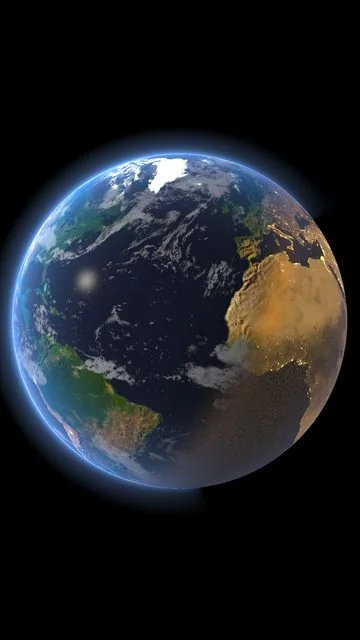 VIIIThe world we know
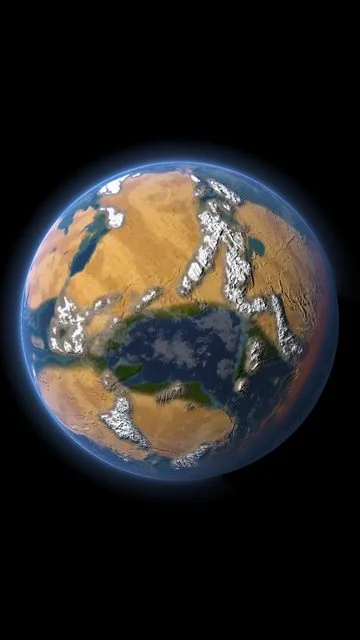 IXFour possible futures
Chapter by chapter
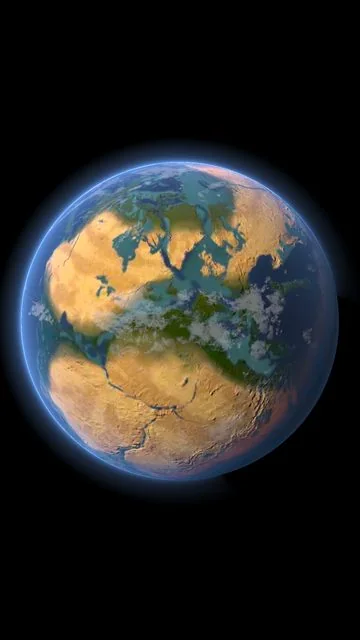
Chapter I One after another Free
every few hundred million years.
You start above Pangaea, 250 million years ago, when almost all of Earth's land formed a single continent. It is the famous one, but the chapter's point is that it was not unique: land has crashed together like this before, and it will again.
Geologists call this rhythm the supercontinent cycle. Oceans open and close, and every few hundred million years most of the continents end up in one piece before breaking apart [1]. The Pangaea you see is placed by a published full-plate model, a reconstruction of every tectonic plate through the last billion years [2].
Chapter II A world of water Free
4 billion years ago.
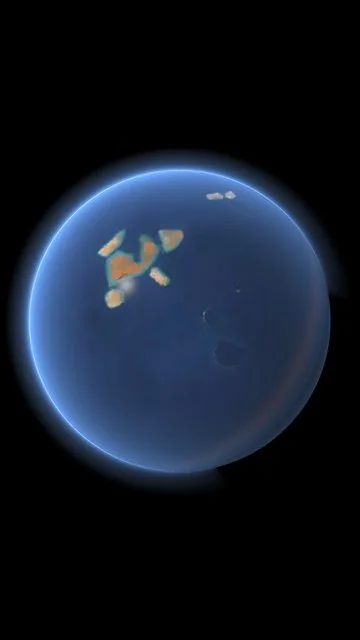
Rewind four billion years and Earth is a world of water. Continental crust has already begun to form, but almost none of it stands above the waves, and most of that first crust sinks back into the mantle. Only a few pieces survive.
The oldest known pieces of Earth are tiny zircon crystals from Western Australia, 4.4 billion years old, and they already hint at continental crust and oceans [3]. When wide areas of dry land first rose above the sea is still debated; oxygen isotopes in ancient shales point to a rapid emergence of land around 2.5 billion years ago [4]. No map of this early world survives, so the chapter is an illustration, not a reconstruction.
Chapter III The first survivors Free
3.6 to 2.6 billion years ago.
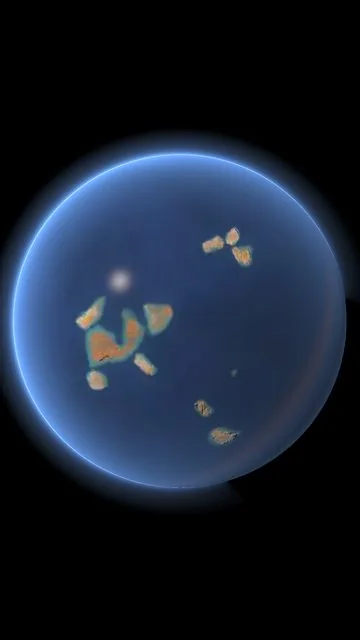
The oldest big pieces of crust still around are the Pilbara in Western Australia and the Kaapvaal in South Africa. The chapter weighs two ideas about where they sat: in Ur, a small continent of three billion years ago that also held pieces of India, or side by side, as Vaalbara. Then cratons, the old and stable hearts of continents, cluster together.
Parts of the Kaapvaal and the Pilbara are the last pristine crust left from 3.6 to 2.7 billion years ago [5]. Ur was proposed in 1996 [6]; Vaalbara has a magnetic test in its favor, because the two cratons' ancient magnetism lines up when they sit together [7], so the Story bets on Vaalbara. Whether the later cluster was one supercontinent, Kenorland, or several groups that broke up at different times is debated [8]; the Story bets on several.
Chapter IV Nuna and the boring billion Free
1.8 to 1 billion years ago.
From 1.8 billion years ago a full plate model can follow every piece, and you watch the cratons weld into a supercontinent called Nuna, or Columbia. Then comes a long, quiet stretch when climate and life barely change. Underneath, Nuna is already breaking up and its pieces are regrouping.
The core of Nuna assembled around 1.8 billion years ago [9]. The positions here come from a model of plate boundaries over the last 1.8 billion years [10]. The quiet stretch that followed is nicknamed the boring billion, after a study that described a billion years of environmental stability before complex cells, the eukaryotes, took hold [11].
Chapter V Rodinia and Snowball Earth Plus
1 billion to 560 million years ago.
A billion years ago the pieces dock again, into Rodinia. Then the ice comes: glaciers creep from both poles to the equator and the whole planet turns white. The ice holds for tens of millions of years, until carbon dioxide from volcanoes melts it, fast. Then the planet freezes over a second time.
Rodinia held together from about a billion to 750 million years ago [2][12]. The two Snowball Earth glaciations are well dated: the Sturtian from about 717 to 659 million years ago, and the shorter Marinoan, which ended about 635 million years ago [13][14]. With the land under ice, carbon dioxide from volcanoes builds up in the air until the greenhouse wins [13]. At the end some geologists see one more brief supercontinent, Pannotia; others doubt it ever fully formed [15].
Chapter VI Pangaea Plus
540 to 250 million years ago.
After the ice, life explodes in the seas, and the first plants creep onto land. Then every continent collides into one: Pangaea, its heart a desert too far from the sea for rain. The chapter stops to ask how we know, and ends as Siberia erupts.
Some of the earliest land-plant spores, from Argentina, date to about 470 million years ago [16]. Pangaea came together between about 320 and 250 million years ago [2]. The clues the chapter shows are the kind Alfred Wegener used when he proposed continental drift in 1912: the same fossils on coasts now oceans apart, like the freshwater reptile Mesosaurus in Brazil and Namibia and the seed fern Glossopteris in India and Antarctica [17][18]. The Appalachians and the Scottish Highlands are one old mountain belt, raised when an earlier ocean closed [19]. The Siberian eruptions came with the end-Permian extinction 252 million years ago, the worst loss of life in the sea and on land in the last 542 million years [20].
Chapter VII Breaking apart Plus
200 to 66 million years ago.
About 200 million years ago Pangaea starts to tear, and a new ocean is born: the Atlantic. India breaks away and races north. Then an asteroid about 10 kilometers wide strikes Mexico while India's Deccan volcanoes are erupting, and the age of the dinosaurs ends. Not all of them: some made it through, and we call them birds.
The central Atlantic began to open around 200 to 180 million years ago [21], and India moved north at up to about 18 centimeters a year [22]. The impact is dated to 66 million years ago, within about 33,000 years of the extinction [23], and the Chicxulub crater is firmly tied to it [24][25]. The Deccan Traps erupted in great pulses around the same time, the first before the impact [26]. Birds are the one line of dinosaurs that survived [27]. The idea that a supercontinent traps the planet's heat like a lid until it cracks is a hypothesis [28].
Chapter VIII The world we know Plus
50 million years ago to today.
India slams into Asia and the Himalaya rise. Then the globe reaches today, and the continents are still moving, about as fast as your fingernails grow.
Sediments in southern Tibet date the start of the India–Asia collision to about 59 million years ago [29]. Spreading at the Mid-Atlantic Ridge averages about 2.5 centimeters a year [30], and thousands of GPS stations now track the plates directly, to a fraction of a millimeter a year [31].
Chapter IX Four possible futures Plus
the next 250 million years.
Oceans close where old seafloor sinks into deep trenches, and most trenches ring the Pacific. The chapter plays four futures, 200 to 250 million years ahead: Pangaea Proxima, where the Atlantic closes; Novopangaea, where the Pacific closes and Antarctica drifts north; Aurica, where both close and a new ocean splits Asia; and Amasia, where everything piles up around the North Pole.
These are published scenarios, not forecasts [32]. A 2022 model of the mantle and plates found that today's weaker ocean plates favor closing the Pacific, which points to Amasia [33], the Story's bet. A climate model of Pangaea Proxima (also called Pangaea Ultima) found it so hot, and so far from the sea, that only 8 to 16 percent of its land could suit mammals [34]. Our species is about 300,000 years old [35], roughly a thousandth of the way there. The odds the chapter shows are Everdust's own call, and whichever supercontinent forms will tear apart again.
What’s simulated, and what isn’t
The continents move on published plate models: a full-plate reconstruction for the last billion years, a second model from 1.8 to 1 billion years ago, and four published scenarios for the future. Coastlines are today's, carried back in time, not ancient shorelines. Before 1.8 billion years ago there is no model, so the cratons are Everdust's own coarse sketch, with only their arrangement taken from the papers. Deserts and forests are inferred from latitude and distance to the sea, relief is exaggerated and the clouds are today's. Between the published future maps the motion is Everdust's own fit.
Watch The Story of the Continents in Everdust
The Story of the Continents is in the Everdust app on Android now, and coming to iPhone, iPad and Apple Vision Pro. Open Everdust, choose Stories, then The Story of the Continents. Free: chapters I–IV. Everdust Plus: chapters V–IX.
Everdust on Google Play (Android)
Everdust is free to download, with no ads and no account. Everdust Plus, an optional subscription, opens every chapter of every Story on Android.
Questions people ask
What was the first supercontinent? No one knows for sure. Vaalbara, joining the Kaapvaal and Pilbara cratons, may go back more than 3 billion years [5]. Nuna, about 1.8 billion years ago, is the first one a full plate model can follow [9].
When did Pangaea form and break up? Pangaea assembled between about 320 and 250 million years ago [2], and it began to break up as the central Atlantic opened, around 200 to 180 million years ago [21].
What will the next supercontinent be? Nobody knows. Four main scenarios have been published: Pangaea Proxima, Novopangaea, Aurica and Amasia [32]. A 2022 model favors Amasia, formed by closing the Pacific [33].
Sources
- Nance, R. D., Murphy, J. B. & Santosh, M. (2014). The supercontinent cycle: a retrospective essay. Gondwana Research 25, 4.
- Merdith, A. S. et al. (2021). Extending full-plate tectonic models into deep time: linking the Neoproterozoic and the Phanerozoic. Earth-Science Reviews 214, 103477.
- Wilde, S. A. et al. (2001). Evidence from detrital zircons for the existence of continental crust and oceans on the Earth 4.4 Gyr ago. Nature 409, 175.
- Bindeman, I. N. et al. (2018). Rapid emergence of subaerial landmasses and onset of a modern hydrologic cycle 2.5 billion years ago. Nature 557, 545.
- Zegers, T. E., de Wit, M. J., Dann, J. & White, S. H. (1998). Vaalbara, Earth's oldest assembled continent? A combined structural, geochronological, and palaeomagnetic test. Terra Nova 10, 250.
- Rogers, J. J. W. (1996). A history of continents in the past three billion years. The Journal of Geology 104, 91.
- de Kock, M. O., Evans, D. A. D. & Beukes, N. J. (2009). Validating the existence of Vaalbara in the Neoarchean. Precambrian Research 174, 145.
- Bleeker, W. (2003). The late Archean record: a puzzle in ca. 35 pieces. Lithos 71, 99.
- Evans, D. A. D. & Mitchell, R. N. (2011). Assembly and breakup of the core of Paleoproterozoic–Mesoproterozoic supercontinent Nuna. Geology 39, 443.
- Cao, X. et al. (2024). Earth's tectonic and plate boundary evolution over 1.8 billion years. Geoscience Frontiers 15, 101922.
- Brasier, M. D. & Lindsay, J. F. (1998). A billion years of environmental stability and the emergence of eukaryotes: new data from northern Australia. Geology 26, 555.
- Li, Z. X. et al. (2008). Assembly, configuration, and break-up history of Rodinia: a synthesis. Precambrian Research 160, 179.
- Hoffman, P. F. et al. (2017). Snowball Earth climate dynamics and Cryogenian geology-geobiology. Science Advances 3, e1600983.
- Rooney, A. D. et al. (2015). A Cryogenian chronology: two long-lasting synchronous Neoproterozoic glaciations. Geology 43, 459.
- Evans, D. A. D. (2020). Pannotia under prosecution. Geological Society, London, Special Publications 503, 63.
- Rubinstein, C. V. et al. (2010). Early Middle Ordovician evidence for land plants in Argentina (eastern Gondwana). New Phytologist 188, 365.
- Wegener, A. (1912). Die Entstehung der Kontinente. Geologische Rundschau 3, 276.
- U.S. Geological Survey. This Dynamic Earth: Historical perspective.
- Wilson, J. T. (1966). Did the Atlantic close and then re-open? Nature 211, 676.
- Burgess, S. D., Bowring, S. & Shen, S.-Z. (2014). High-precision timeline for Earth's most severe extinction. Proceedings of the National Academy of Sciences 111, 3316.
- Labails, C. et al. (2010). An alternative early opening scenario for the Central Atlantic Ocean. Earth and Planetary Science Letters 297, 355.
- Pusok, A. E. & Stegman, D. R. (2020). The convergence history of India-Eurasia records multiple subduction dynamics processes. Science Advances 6, eaaz8681.
- Renne, P. R. et al. (2013). Time scales of critical events around the Cretaceous-Paleogene boundary. Science 339, 684.
- Alvarez, L. W. et al. (1980). Extraterrestrial cause for the Cretaceous-Tertiary extinction. Science 208, 1095.
- Schulte, P. et al. (2010). The Chicxulub asteroid impact and mass extinction at the Cretaceous-Paleogene boundary. Science 327, 1214.
- Schoene, B. et al. (2019). U-Pb constraints on pulsed eruption of the Deccan Traps across the end-Cretaceous mass extinction. Science 363, 862.
- Brusatte, S. L., O'Connor, J. K. & Jarvis, E. D. (2015). The origin and diversification of birds. Current Biology 25, R888.
- Coltice, N. et al. (2007). Global warming of the mantle at the origin of flood basalts over supercontinents. Geology 35, 391.
- Hu, X., Garzanti, E., Moore, T. & Raffi, I. (2015). Direct stratigraphic dating of India-Asia collision onset at the Selandian (middle Paleocene, 59 ± 1 Ma). Geology 43, 859.
- U.S. Geological Survey. This Dynamic Earth: Understanding plate motions.
- Blewitt, G., Kreemer, C., Hammond, W. C. & Gazeaux, J. (2016). MIDAS robust trend estimator for accurate GPS station velocities without step detection. Journal of Geophysical Research: Solid Earth 121, 2054.
- Davies, H. S., Green, J. A. M. & Duarte, J. C. (2018). Back to the future: testing different scenarios for the next supercontinent gathering. Global and Planetary Change 169, 133.
- Huang, C., Li, Z.-X. & Zhang, N. (2022). Will Earth's next supercontinent assemble through the closure of the Pacific Ocean? National Science Review 9, nwac205.
- Farnsworth, A. et al. (2023). Climate extremes likely to drive land mammal extinction during next supercontinent assembly. Nature Geoscience 16, 901.
- Hublin, J.-J. et al. (2017). New fossils from Jebel Irhoud, Morocco and the pan-African origin of Homo sapiens. Nature 546, 289.
Plates over the last billion years: Merdith et al. (2021), model files doi:10.5281/zenodo.10346399, CC BY 4.0, modified. Plates from 1.8 to 1 billion years ago: Müller, Dutkiewicz, Farkas, Merdith & Löhr (2025), Muller2025 plate model based on Cao et al. (2024), Zenodo, doi:10.5281/zenodo.15233548, CC BY 4.0, modified. Pangaea Proxima: PALEOMAP Global Plate Model, C. R. Scotese (2016), in Scotese & Wright (2018), PALEOMAP PaleoAtlas, Zenodo, doi:10.5281/zenodo.5460860, CC BY 4.0, modified. Novopangaea, Aurica and Amasia: Davies, Green & Duarte (2018); land and ocean grids from Davies, Green & Duarte (2020), doi:10.17605/OSF.IO/8NEQ4, CC0. The motion between their maps is Everdust's own fit, not the authors' model. Earliest cratons: a sketch drawn by Everdust, arranged after Bleeker (2003), de Kock, Evans & Beukes (2009) and Rogers (1996). Relief: NOAA National Centers for Environmental Information, ETOPO 2022 Global Relief Model, doi:10.25921/fd45-gt74, public domain (CC0). Today's surface, clouds and city lights: NASA Blue Marble: Next Generation (Reto Stöckli, NASA GSFC), NASA Blue Marble cloud composite and Black Marble 2016 (NASA Earth Observatory, Joshua Stevens; Suomi NPP VIIRS data, Miguel Román, NASA GSFC). No NASA endorsement is implied. Chapter stills: Everdust, from each chapter’s live simulation. The Story’s script was written for Everdust from the sources above; River reads it. This page retells it in its own words.