What is a supercontinent? Pangaea, Rodinia, Nuna and the cycle that builds them
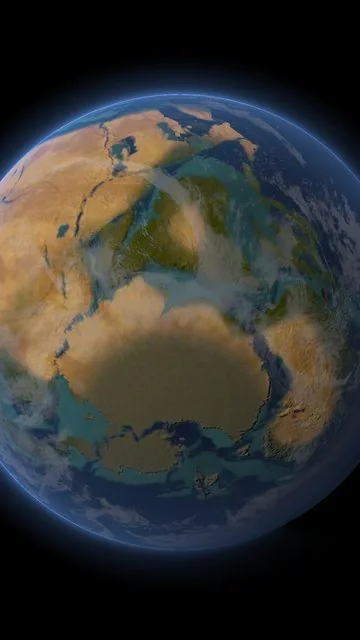
A supercontinent is a time when most of Earth's continents are joined in a single landmass. Pangaea, which came together between about 320 and 250 million years ago, is the most recent and the best known [1], but it was not the first. Geologists have found the remains of several older ones, and the way the plates move today suggests another will form in about 250 million years [2].
What counts as a supercontinent
There is no strict cutoff, but the idea is simple: most of the world's continental crust gathered in one piece, surrounded by one great ocean. Pangaea's name means "all lands" in Greek, and it was central to the theory of continental drift that Alfred Wegener put forward in 1912, the forerunner of plate tectonics [3][4].
Smaller gatherings sit in between. Gondwana, which gathered the southern continents, lasted about 300 million years and has been called a semi-supercontinent; one review argues it may have mattered more to the deep Earth than Pangaea did [5].
The supercontinent cycle
Continents are the thick, light parts of tectonic plates, and they ride along as the plates move. Oceans open where plates pull apart and close where old seafloor sinks back into the mantle at deep trenches. In 1966 J. Tuzo Wilson asked whether the Atlantic had closed and then reopened, and argued that it had: the Appalachians and the Scottish Highlands are the scar of an older ocean that closed before today's Atlantic opened [6].
Repeat that opening and closing across the whole planet and the continents periodically end up together. This rhythm, roughly every few hundred million years, is the supercontinent cycle [7]. It is not a clock: the gaps vary, and the record gets harder to read the further back you go.
Earth's supercontinents, oldest first
Before 2.5 billion years ago the evidence is thin. The Kaapvaal craton of South Africa and the Pilbara of Western Australia hold the last pristine crust from 3.6 to 2.7 billion years ago, and they may once have been joined as Vaalbara [8][9]. Around 2.7 billion years ago the cratons clustered, either as one supercontinent, Kenorland, or as several separate groups [10].
Nuna, also called Columbia, assembled about 1.8 billion years ago [11]. Rodinia followed, holding together from about a billion to 750 million years ago [12][1]. Pannotia, at the end of the Precambrian, is the most disputed: one review finds no compelling evidence that it ever existed [5]. Pangaea assembled between about 320 and 250 million years ago and began to break up as the central Atlantic opened, around 200 to 180 million years ago [1][13].
How do we know where the continents were?
The first clues were matching fossils and rocks on coasts now separated by oceans. Wegener saw that identical fossil species turn up along the coasts of Africa and South America, and that the seed fern Glossopteris grew in places now near the poles [4]. A freshwater reptile like Mesosaurus, found in both Brazil and southern Africa, could never have swum an ocean.
Today the strongest tool is paleomagnetism. Some rocks lock in the direction of Earth's magnetic field as they form, which records how far from the equator they were. When two cratons' records only agree if you put them side by side, as the Kaapvaal's and the Pilbara's do, that is strong evidence they traveled together [9]. Full-plate models combine this frozen magnetism with fossils, mountain belts and other geology to rebuild every plate through time, and their uncertainty grows with age [1][14].
Why supercontinents form and break apart
They form because oceans close. Old ocean floor is cold and dense, and where it sinks at a trench it drags its plate along; this slab pull may provide about half of the force that drives plates today [15]. Whether a new supercontinent forms by closing the young oceans inside the old one or the old ocean outside it may depend on how strong ocean plates are, which changes as Earth cools [16].
Why they break up is less settled. One hypothesis is that a supercontinent acts like a lid, trapping the mantle's heat beneath it until the land swells and cracks and lava floods out [17]. It is a hypothesis, not a measurement, and The Story of the Continents presents it that way.
The next supercontinent
Plates still move a few centimeters a year [18], and four main scenarios for the next supercontinent have been published [19]. In Pangaea Proxima the Atlantic closes and the Americas swing back into Africa and Europe. In Novopangaea the Pacific closes instead. In Aurica both oceans close and a new one splits Asia. In Amasia the continents gather around the North Pole.
A 2022 model of the mantle and plates favors Amasia, formed by closing the Pacific [16]. A climate study of Pangaea Proxima found that stronger sunshine, more carbon dioxide and a huge interior far from the sea would make most of it too hot for mammals, leaving only 8 to 16 percent of the land habitable for them [2].
Watch it in Everdust
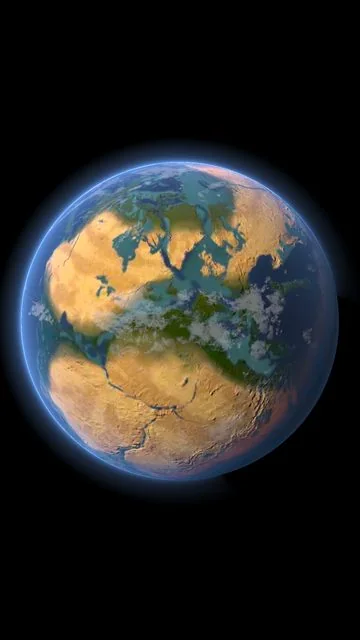
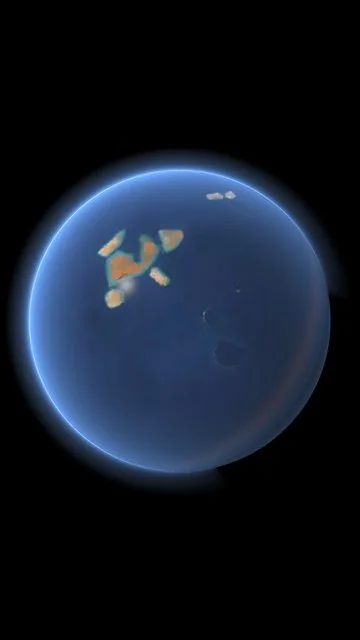
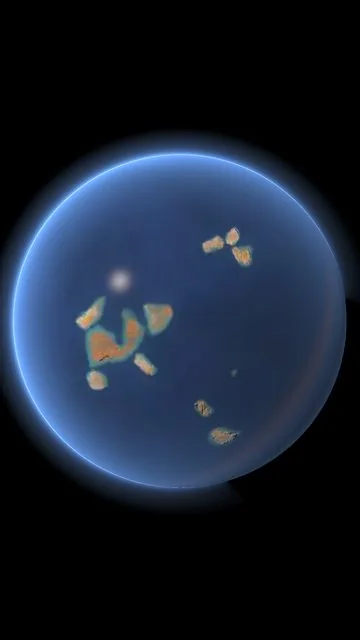
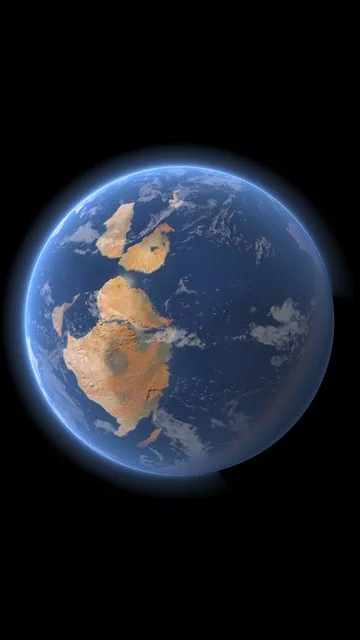
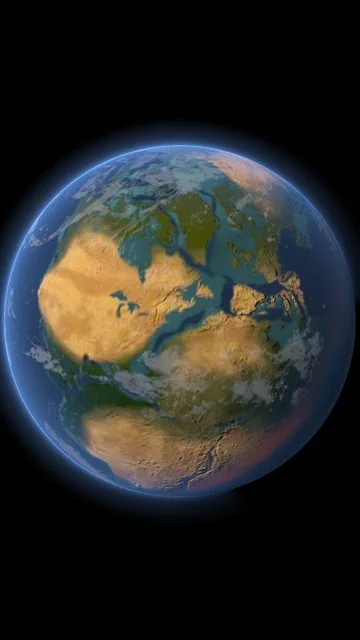
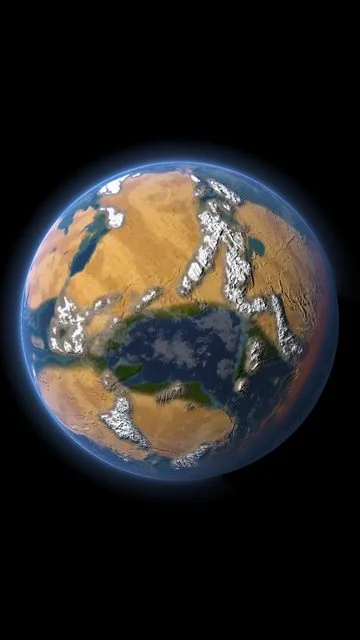
Pangaea is Chapter VI of The Story of the Continents. On a turning globe the continents converge into one, the chapter lays out the clues that convinced geologists, and then Siberia erupts. The positions come from a published plate model; the coastlines are today's, carried back in time, and the deserts and forests are inferred, not mapped. Other chapters visit Nuna, Rodinia and the four possible futures, and the Supercontinents chapter of Restless Earth, a Story coming to Everdust, replays the last billion years on the same model.
Watch it in Everdust
The Story of the Continents is in the Everdust app on Android now, and coming to iPhone, iPad and Apple Vision Pro. Open Everdust, choose Stories, then The Story of the Continents; Pangaea is chapter 6. Free: chapters I–IV. Everdust Plus: chapters V–IX.
Everdust on Google Play (Android)
Everdust is free to download, with no ads and no account. Everdust Plus, an optional subscription, opens every chapter of every Story on Android.
The rest of the Story, chapter by chapter: The Story of the Continents.
Questions people ask
What was the last supercontinent? Pangaea. It assembled between about 320 and 250 million years ago and began breaking up around 200 million years ago, when the central Atlantic opened [1][13].
How many supercontinents has Earth had? At least three are widely accepted: Nuna, Rodinia and Pangaea [11][12]. Older ones such as Vaalbara and Kenorland, and the brief Pannotia, are still debated [10][5].
When will the next supercontinent form? In roughly 250 million years, if the plates keep moving as models expect [2]. Which shape it will take is unknown; four scenarios have been published [19].
Sources
- Merdith, A. S. et al. (2021). Extending full-plate tectonic models into deep time: linking the Neoproterozoic and the Phanerozoic. Earth-Science Reviews 214, 103477.
- Farnsworth, A. et al. (2023). Climate extremes likely to drive land mammal extinction during next supercontinent assembly. Nature Geoscience 16, 901.
- Wegener, A. (1912). Die Entstehung der Kontinente. Geologische Rundschau 3, 276.
- U.S. Geological Survey. This Dynamic Earth: Historical perspective.
- Evans, D. A. D. (2020). Pannotia under prosecution. Geological Society, London, Special Publications 503, 63.
- Wilson, J. T. (1966). Did the Atlantic close and then re-open? Nature 211, 676.
- Nance, R. D., Murphy, J. B. & Santosh, M. (2014). The supercontinent cycle: a retrospective essay. Gondwana Research 25, 4.
- Zegers, T. E., de Wit, M. J., Dann, J. & White, S. H. (1998). Vaalbara, Earth's oldest assembled continent? A combined structural, geochronological, and palaeomagnetic test. Terra Nova 10, 250.
- de Kock, M. O., Evans, D. A. D. & Beukes, N. J. (2009). Validating the existence of Vaalbara in the Neoarchean. Precambrian Research 174, 145.
- Bleeker, W. (2003). The late Archean record: a puzzle in ca. 35 pieces. Lithos 71, 99.
- Evans, D. A. D. & Mitchell, R. N. (2011). Assembly and breakup of the core of Paleoproterozoic–Mesoproterozoic supercontinent Nuna. Geology 39, 443.
- Li, Z. X. et al. (2008). Assembly, configuration, and break-up history of Rodinia: a synthesis. Precambrian Research 160, 179.
- Labails, C. et al. (2010). An alternative early opening scenario for the Central Atlantic Ocean. Earth and Planetary Science Letters 297, 355.
- Cao, X. et al. (2024). Earth's tectonic and plate boundary evolution over 1.8 billion years. Geoscience Frontiers 15, 101922.
- Conrad, C. P. & Lithgow-Bertelloni, C. (2002). How mantle slabs drive plate tectonics. Science 298, 207.
- Huang, C., Li, Z.-X. & Zhang, N. (2022). Will Earth's next supercontinent assemble through the closure of the Pacific Ocean? National Science Review 9, nwac205.
- Coltice, N. et al. (2007). Global warming of the mantle at the origin of flood basalts over supercontinents. Geology 35, 391.
- U.S. Geological Survey. This Dynamic Earth: Understanding plate motions.
- Davies, H. S., Green, J. A. M. & Duarte, J. C. (2018). Back to the future: testing different scenarios for the next supercontinent gathering. Global and Planetary Change 169, 133.