How ATP synthase works: the molecular turbine that makes your body's energy
ATP synthase is a molecular machine that makes ATP, the molecule your cells spend for energy, and it works like a turbine. Protons flowing across the inner membrane of a mitochondrion turn a rotor in its base, and the rotor's shaft turns inside the enzyme's head, which joins ADP and phosphate into ATP, three molecules for every full turn [1]. It makes most of the ATP in cells like yours [2], and you get through roughly your own body weight in ATP every day [3].
Where the power comes from: a proton dam
In 1961 Peter Mitchell proposed that the energy from food is first stored as a difference in protons across a membrane, which then drives the making of ATP [4]. In mitochondria the proton pumps of the electron transport chain, Complexes I, III and IV, push protons out of the inner compartment, leaving the membrane charged like a battery; that voltage, together with the difference in acidity, is what the cell harnesses to make ATP [5].
The protons' way back runs through ATP synthase. Their flow is coupled mechanically to making ATP, by turning a ring in the membrane and a shaft attached to it [1].
The parts: a rotor, a shaft and a head
ATP synthase has two halves. In the membrane sits a ring of small c-subunits, the rotor. A central stalk, the shaft, runs from the ring up into the catalytic head, which sticks out into the mitochondrion's matrix, and a peripheral stalk holds the head still, like the casing of a turbine [1].
The first atomic structure of the head, solved in John Walker's laboratory in 1994, showed its three catalytic beta subunits in three different states around an asymmetric shaft [6], just what Paul Boyer's binding-change idea needed [7]. In 2020 cryo-electron microscopy gave the structure of the entire mammalian enzyme, from sheep, rotor and stalks included [2].
How protons turn the rotor
Each c-subunit carries a glutamate, an acidic amino acid, near the middle of the membrane. A proton arriving from one side lands on a glutamate, the ring turns, and the proton is released on the other side; picking up and dropping protons on each glutamate in turn is what drives the rotation [1].
In mammals the ring has eight c-subunits, so one full turn moves eight protons and makes three ATP: about 2.7 protons for each ATP. Fungi, bacteria and plant chloroplasts have rings of 10 to 15 subunits, so they need 3.3 to 5 protons for each ATP [1]. Mammals get more ATP for the same protons.
How the head makes ATP: binding change
The head doesn't spin. As the shaft turns inside it, each of the three catalytic sites is pushed through three shapes in turn: one loosely holds ADP and phosphate, one squeezes them together into ATP, and one opens to let the ATP go. This is the binding-change mechanism, with the shaft's rotation inside the head setting the rhythm [7]. Each third of a turn finishes one ATP, so a full turn makes three.
Boyer and Walker shared half of the 1997 Nobel Prize in Chemistry for working out the mechanism behind making ATP [8].
Watching a single motor spin
In 1997 Hiroyuki Noji, Kazuhiko Kinosita and colleagues attached a fluorescent actin filament to the shaft of a single F1 head, the enzyme's catalytic half, and watched it turn under a microscope as the enzyme burned ATP: more than a hundred revolutions, always the same way [9]. The motor turns in discrete 120-degree steps, one for each ATP [10], and each step splits into smaller substeps; at full speed a free F1 head turns about 130 times a second [11].
In the membrane, driven by protons, the whole machine turns about a hundred times a second [1].
Running backwards, and the brake
The machine can run in reverse. When respiration fails and the voltage drops, ATP synthase turns the other way, burning ATP to pump protons. A small protein called IF1 limits this, saving ATP; it also affects how many folds the mitochondrion has and how many synthases pair up [12].
Pairs that shape the membrane
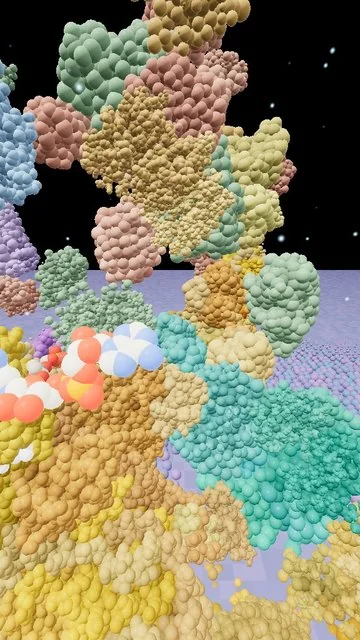
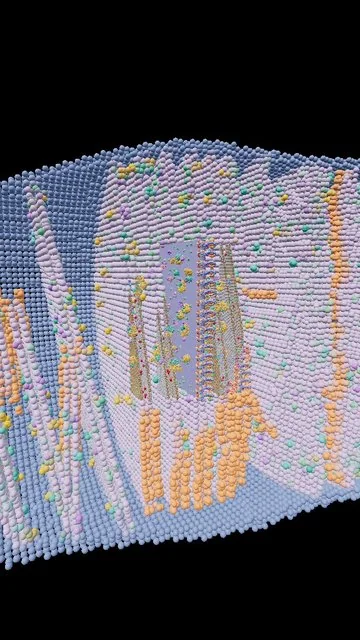
ATP synthase works in pairs. Imaging of whole mitochondria from cow heart, potato and fungi found long rows of these dimers only along the tightly curved edges of the cristae, the folds of the inner membrane, with the proton pumps on the flatter parts nearby [13]. The rows of dimers bend the membrane themselves, so the turbines help build the folds they sit on [14].
Watch it in Everdust
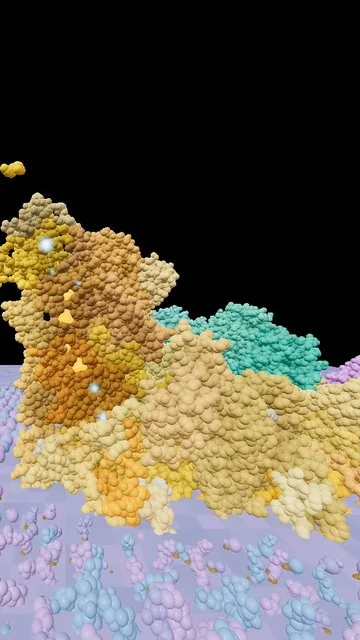
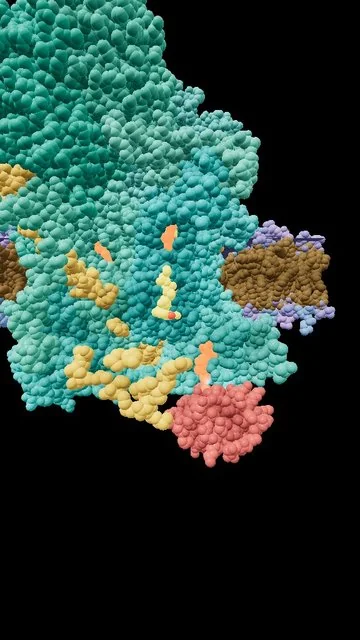
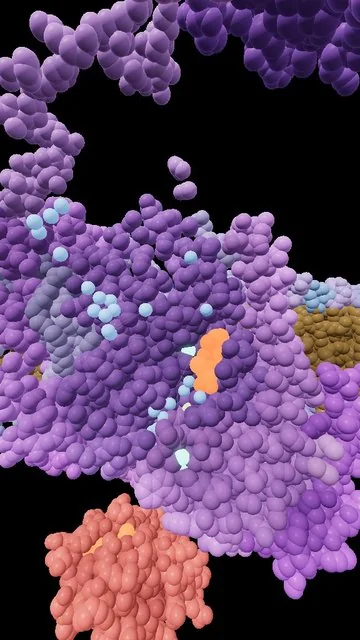
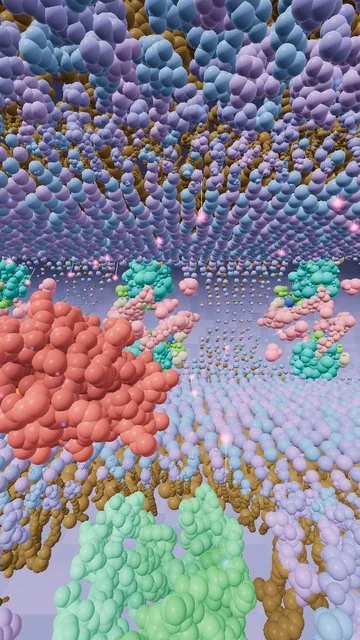
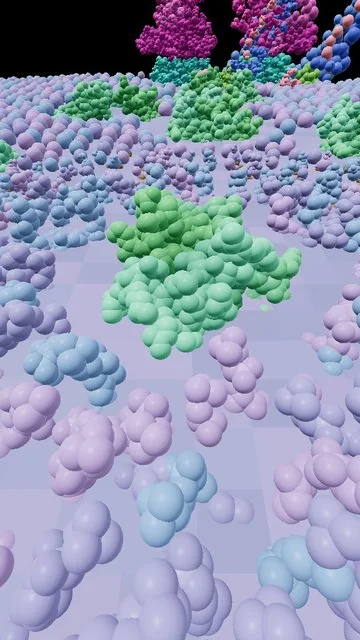
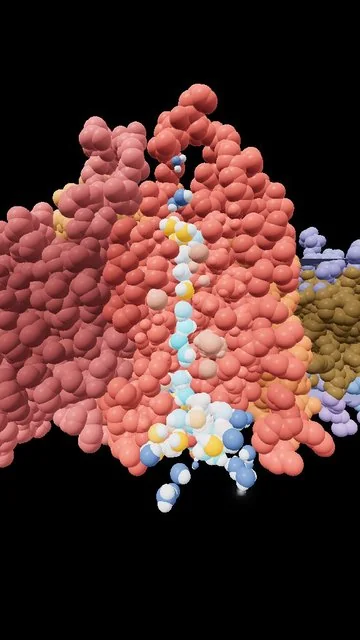
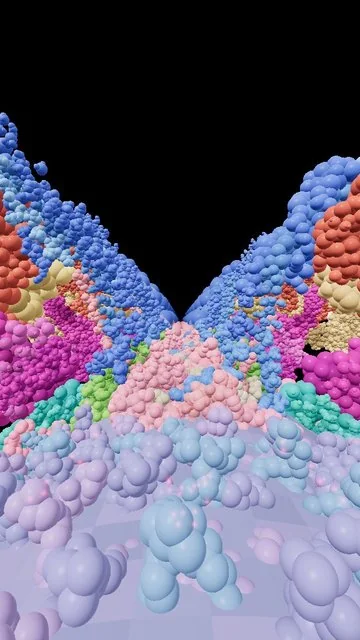
ATP synthase is Chapter VI of The Power Plant: a row of real dimers on the rim of a fold, built from the sheep structure with every atom in place, one head cut open toward you. The rotor steps a third of a turn at a time and an ATP leaves the head at each step. Its speed comes from a simple thermodynamic model, about 170 ATP a second per enzyme at 200 millivolts, stalling below about 179, and it is shown 200 times slower so you can follow it. Drop the gradient and it stalls. The protons are drawn as dots; real ones hop along water.
Watch it in Everdust
The Power Plant: how your cells make energy is in the Everdust app on iPhone and iPad, Android, Apple Vision Pro, Mac, Apple TV and Meta Quest 3 and 3S. Open Everdust, choose Stories, then The Power Plant: how your cells make energy; The turbine is chapter 6. Free: chapters I–III. Everdust Plus: chapters IV–IX.
Everdust on the App Store (iPhone, iPad, Apple Vision Pro, Mac, Apple TV)Everdust on Google Play (Android)Everdust on the Meta Horizon Store (Quest 3 and 3S)
Everdust is free to download, with no ads and no account. Everdust Plus, an optional subscription, opens every chapter of every Story on iPhone, iPad, Android, Apple Vision Pro, Mac and Apple TV (on Meta Quest, which chapters are free can differ).
The rest of the Story, chapter by chapter: The Power Plant: how your cells make energy.
Questions people ask
How many ATP does one turn of ATP synthase make? Three, one from each of the head's three catalytic sites. In mammals one full turn uses eight protons [1].
How fast does ATP synthase spin? In mitochondria the rotor turns about 100 times a second [1]. An isolated F1 head running on ATP reaches about 130 turns a second [11].
Who discovered how ATP synthase works? Paul Boyer proposed the binding-change mechanism and John Walker's group solved the structure that supported it; they shared half of the 1997 Nobel Prize in Chemistry [8][6].
Sources
- Watt, I. N. et al. (2010). Bioenergetic cost of making an adenosine triphosphate molecule in animal mitochondria. Proceedings of the National Academy of Sciences 107, 16823.
- Pinke, G., Zhou, L. & Sazanov, L. A. (2020). Cryo-EM structure of the entire mammalian F-type ATP synthase. Nature Structural & Molecular Biology 27, 1077.
- Törnroth-Horsefield, S. & Neutze, R. (2008). Opening and closing the metabolite gate. Proceedings of the National Academy of Sciences 105, 19565.
- Mitchell, P. (1961). Coupling of phosphorylation to electron and hydrogen transfer by a chemi-osmotic type of mechanism. Nature 191, 144.
- Zorova, L. D. et al. (2018). Mitochondrial membrane potential. Analytical Biochemistry 552, 50.
- Abrahams, J. P., Leslie, A. G. W., Lutter, R. & Walker, J. E. (1994). Structure at 2.8 Å resolution of F1-ATPase from bovine heart mitochondria. Nature 370, 621.
- Boyer, P. D. (1997). The ATP synthase: a splendid molecular machine. Annual Review of Biochemistry 66, 717.
- Nobel Prize Outreach. The Nobel Prize in Chemistry 1997.
- Noji, H., Yasuda, R., Yoshida, M. & Kinosita, K. (1997). Direct observation of the rotation of F1-ATPase. Nature 386, 299.
- Yasuda, R., Noji, H., Kinosita, K. & Yoshida, M. (1998). F1-ATPase is a highly efficient molecular motor that rotates with discrete 120° steps. Cell 93, 1117.
- Yasuda, R. et al. (2001). Resolution of distinct rotational substeps by submillisecond kinetic analysis of F1-ATPase. Nature 410, 898.
- Campanella, M. et al. (2008). Regulation of mitochondrial structure and function by the F1Fo-ATPase inhibitor protein, IF1. Cell Metabolism 8, 13.
- Davies, K. M. et al. (2011). Macromolecular organization of ATP synthase and complex I in whole mitochondria. Proceedings of the National Academy of Sciences 108, 14121.
- Strauss, M., Hofhaus, G., Schröder, R. R. & Kühlbrandt, W. (2008). Dimer ribbons of ATP synthase shape the inner mitochondrial membrane. The EMBO Journal 27, 1154.