Evolution in a Box: an artificial-life world where tiny inherited brains evolve, in eight live chapters
Evolution in a Box is an artificial-life world in eight live chapters. Every speck in a glowing ring runs its own tiny brain, inherited from its mother with the odd copying error, and has to harvest light and nutrients to stay alive. Nothing scores them and no one sets a goal: whatever survives and copies itself spreads. River, the narrator, walks you through what came of it.
The chapters follow results from a much bigger research world that Everdust ran on the same rules: random brains starving, families rising and falling, hunters and defenders, loners bonding into bodies once one simple rule changed, and bodies that copy themselves by breaking apart. The Story is just as clear about what did not happen. A test written down in advance looked for members of a body taking lasting, different jobs, and found none.
At a glance
- Chapters
- 8, each a live simulation
- Length
- about 8 minutes played straight through
- Narrator
- River, with subtitles
- Free or Plus
- Free: all 8 chapters
- Where
- Everdust on iPhone and iPad, Android, Apple Vision Pro, Mac, Apple TV and Meta Quest 3 and 3S
 IA box of random brains
 IICopies with typos
 IIIEat or be eaten
 IVSafety in size
 VWhen bodies fuse
 VIBodies that copy themselves
 VIIDo cells take roles?
 VIIIYour box
Chapter by chapter
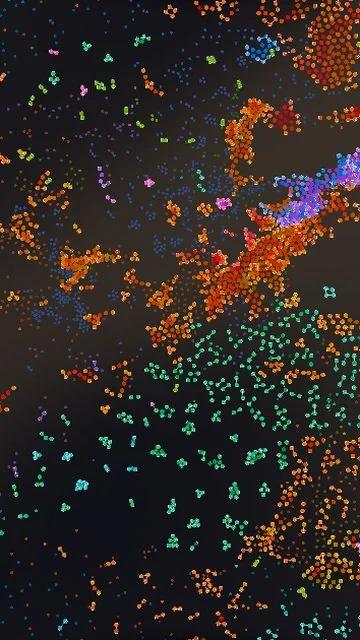
Chapter I A box of random brains
Random tiny brains: most starve, a few make a living and spread.
Every speck in the ring carries a tiny brain of random numbers. It senses light, food and its neighbors and decides what to do. Most random brains can't make a living and run out of energy; when one dies, its matter returns to the ground, so nothing is lost. A few happen to harvest light well enough to grow and divide, and their daughters inherit the same brain and the same color.
Each brain is a small network of artificial neurons whose connections start out random. Energy comes only from light and matter only from nutrients, both counted in whole units and conserved exactly. There is no score anywhere, in the tradition of earlier artificial-life worlds such as Tierra and Avida, where digital organisms copy themselves and evolve [1][2]. The colors are a family marker added so you can follow lineages, not a pigment.
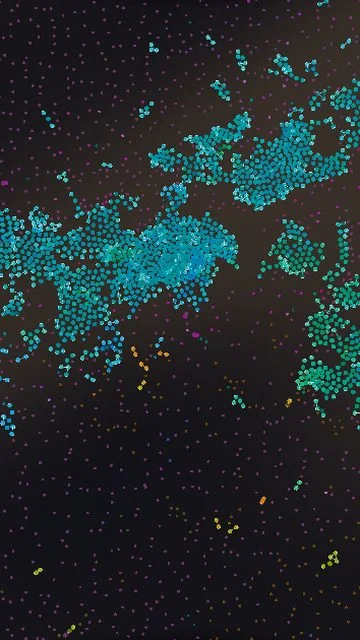
Chapter II Copies with typos
Daughters copy their mother's brain, with the odd typo: families rise and fall.
Every birth copies the mother's brain, usually perfectly. Here one birth in ten adds a small typo, double the research world's rate so the change shows, and a typo also nudges the family color, so relatives look alike. Most typos do nothing or make things worse; a lucky one can let a family outgrow its neighbors. Watch the colors spread, shrink and replace each other.
These families evolved in the bigger research world and were then moved into this fresh one. There, of about sixteen thousand starting families, only about a hundred were left after a hundred thousand steps, and the variety of brains was far lower than in a comparison model where no brain had any advantage. That gap is the mark of strong selection: some brains really were better at staying alive.
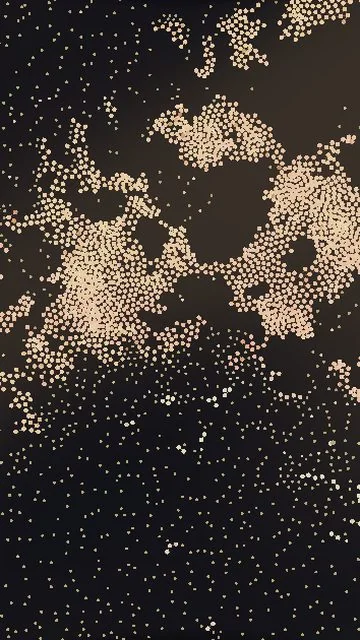
Chapter III Eat or be eaten
Each particle's job: light, nutrient, hunting or defence.
Now color shows each speck's job, not its family. Gold harvests light, cyan takes up nutrient from the ground, red hunts, draining energy and matter from strangers it touches, and violet spends effort on defense, which blunts an attack. Each speck splits its effort among the four, and doing one job well pays more than doing everything a little.
That rule, a trade-off under which specialists beat generalists, is one theorists think matters for the evolution of a division of labor [3]. A hunter keeps all the matter it drains but only part of the energy; the rest is lost as heat. In the big world hunting settled at about a fifth of all effort and defense nearly vanished, a hint that something else was keeping prey safe.
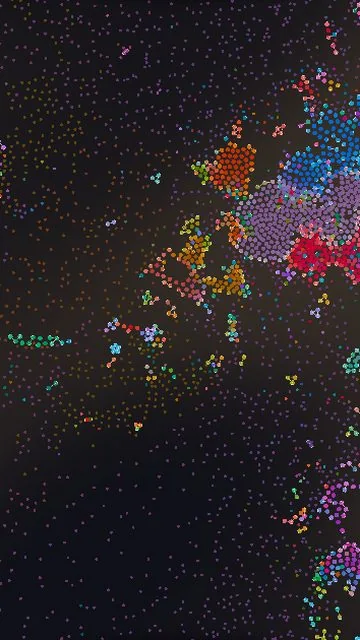
Chapter IV Safety in size
One rule, that a hunter can't swallow prey much bigger than itself, turned loners into bodies.
Specks can bond to neighbors, and each bonded body gets its own color. Bonds cost energy and at first buy no protection: a hunter can drain any stranger it touches, so bodies get eaten at their edges and their share of the ring stays flat. Then one rule changes: a hunter can't swallow prey much bigger than itself. The bodies stop being eaten, and they grow.
Real predators often work this way; biologists call it gape limitation. In experiments, single-celled algae kept with a predator that eats only small prey evolved to live in colonies [4][5]. In Everdust's research world this one rule turned loners into bodies, with three quarters of all specks ending up in one; without it, bonding was a cost and evolution threw it away. The bodies on screen form live, from brains evolved in the research world.
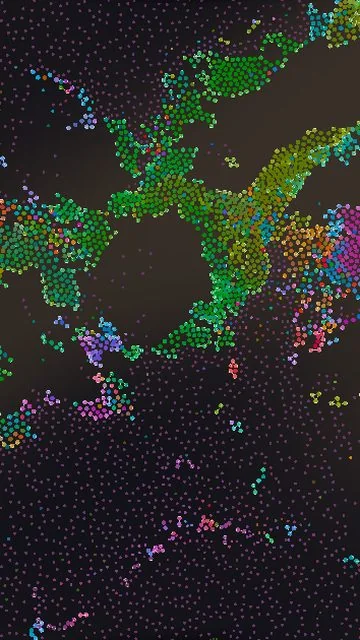
Chapter V When bodies fuse
Bright light crowds the ring and bodies fuse into mats; dim light breaks them into islands.
More sunlight feeds more specks and the ring gets crowded. Crowded bodies touch, bond and fuse into one another until mats sprawl across the ring. Then the light dims: fewer specks can make a living, the crowd spreads out and the big mats break into smaller islands. The chapter raises the light and then drops it so you see both in one run.
Light sets how many specks the world can feed, and more specks mean more contacts and more bonding. In both big research runs one bonded mat came to hold almost half of everything alive, but it was many families glued together, not one creature. In smaller test worlds, lowering the light cut the share of specks in bodies from about a fifth to a few percent. Crowding decides whether bodies stay separate or fuse.
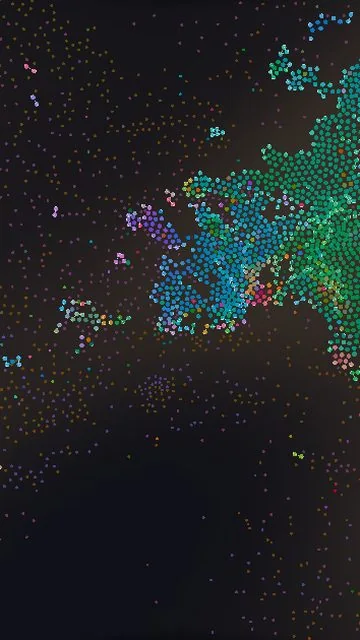
Chapter VI Bodies that copy themselves
Bodies that tear in two and live on: crude copying by breaking apart.
Watch a big body stretch until it tears into pieces. If a piece lives on, the body has made a rough copy of itself. Some simple living things reproduce like this, by breaking apart. The test was strict: both pieces had to survive, and stay the same family.
Everdust wrote that test down before the big world ever ran, a practice called preregistration that separates real predictions from patterns found after the fact [6]. Bodies passed it hundreds of times, far more often than chance would give, and some pieces split again, up to five generations of bodies. It is crude copying, with no plan and no egg, but it resembles reproduction by fragmentation, a way simple multicellular life cycles work [7][8]. The counts come from the research runs, not the ring you see.
Chapter VII Do cells take roles?
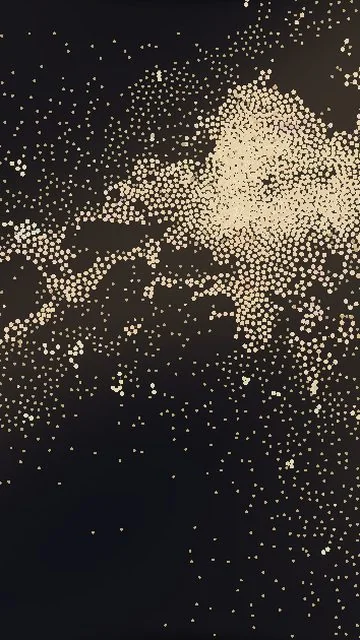
Do particles inside a body take different jobs? Not lastingly: our test found no division of labour.
In your body, cells share the work: some make skin, some make blood. So the chapter asks whether specks inside a body take different jobs. Color shows each speck's job again, gold for light and red for hunting, and the answer is plain to see: almost every member of a body does the same job.
The test, also written down in advance, looked for lasting, distinct roles inside bodies of one family. It checked more than a hundred bodies at two different times and not one passed; one came close, with about four light-eaters for every hunter. In a sparser world four bodies split into light-eaters and hunters for a while, then lost it, and when specialists were rewarded even more, bodies vanished instead. Biologists think a lasting division of labor needs more than a trade-off, such as cues about where each cell sits [9][3]. Bodies that copy themselves emerged here; shared labor did not, not yet.
Chapter VIII Your box
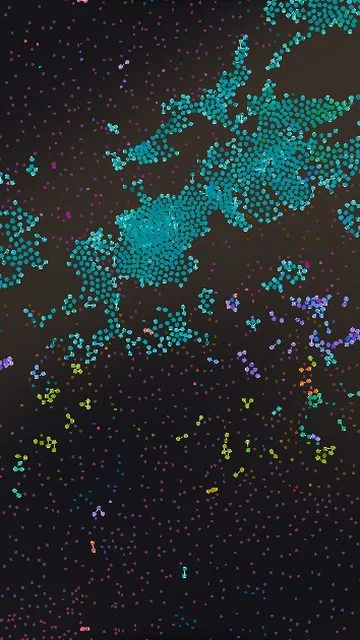
The box is yours: light, hunting and mutation.
The box is yours now: its light, its hunting and its mutation rate. Every rule is the same one the big world ran on. Turn the light up and the ring crowds and fuses; turn hunting down or up; raise mutation and watch families churn.
Matter and energy are still counted exactly, so nothing comes from nowhere: energy enters as light and leaves as heat or stays in a living speck, and matter is either in a speck or in the ground. What evolves is not scripted, so no two runs are alike. It is the place to test the Story's claims yourself: dim the light and see whether bodies still fuse, or turn hunting off and see what bonding is worth without it.
What’s simulated, and what isn’t
Everything in the ring is simulated live: each speck's brain, its sensing, eating, hunting, bonding, dividing and dying, with matter and energy conserved exactly. The colors are false: family markers, jobs or bodies, never pigments. Some chapters raise the mutation rate or switch a rule on partway through so a change shows within a minute. From Chapter II on, the brains in the ring were evolved in a much bigger research world and moved in, and the counts the narration quotes come from those research runs, not from what you see. Apart from each chapter's rule changes, nothing in the ring is scripted.
Watch Evolution in a Box in Everdust
Evolution in a Box is in the Everdust app on iPhone and iPad, Android, Apple Vision Pro, Mac, Apple TV and Meta Quest 3 and 3S. Open Everdust, choose Stories, then Evolution in a Box. Free: all 8 chapters.
Everdust on the App Store (iPhone, iPad, Apple Vision Pro, Mac, Apple TV)Everdust on Google Play (Android)Everdust on the Meta Horizon Store (Quest 3 and 3S)
Everdust is free to download, with no ads and no account. Every chapter of Evolution in a Box is free on iPhone, iPad, Android, Apple Vision Pro, Mac and Apple TV (on Meta Quest, which chapters are free can differ).
Questions people ask
What is artificial life? The study of life-like processes, such as self-copying, evolution and ecology, in computer worlds or other media rather than in living cells. Classic examples are Tierra and Avida, worlds of self-copying digital organisms [1][2].
Did multicellular life evolve in Evolution in a Box? Partly. Loners bonded into bodies, and bodies copied themselves by breaking apart, hundreds of times in the research world. But a test for lasting division of labor between their members found none, so they are not like your body, where cells take different jobs.
What is gape limitation? A limit on the size of prey a predator can eat, set by the size of its mouth or feeding apparatus. In experiments with algae, such predators favored prey that live in colonies [4][5].
Sources
- Ray, T. S. (1993). An evolutionary approach to synthetic biology: Zen and the art of creating life. Artificial Life 1, 179.
- Ofria, C. & Wilke, C. O. (2004). Avida: a software platform for research in computational evolutionary biology. Artificial Life 10, 191.
- Ispolatov, I., Ackermann, M. & Doebeli, M. (2011). Division of labour and the evolution of multicellularity. Proceedings of the Royal Society B: Biological Sciences 279, 1768.
- Boraas, M. E., Seale, D. B. & Boxhorn, J. E. (1998). Phagotrophy by a flagellate selects for colonial prey: a possible origin of multicellularity. Evolutionary Ecology 12, 153.
- Herron, M. D. et al. (2019). De novo origins of multicellularity in response to predation. Scientific Reports 9, 2328.
- Nosek, B. A. et al. (2018). The preregistration revolution. Proceedings of the National Academy of Sciences 115, 2600.
- Pichugin, Y. et al. (2017). Fragmentation modes and the evolution of life cycles. PLOS Computational Biology 13, e1005860.
- Ratcliff, W. C. et al. (2012). Experimental evolution of multicellularity. Proceedings of the National Academy of Sciences 109, 1595.
- Michod, R. E. (2006). The group covariance effect and fitness trade-offs during evolutionary transitions in individuality. Proceedings of the National Academy of Sciences 103, 9113.
Chapter stills: Everdust, from each chapter’s live simulation. The Story’s script was written for Everdust from the sources above; River reads it. This page retells it in its own words.