Anatomy of a Thought II: the same question through a 27-billion-parameter model, and a harder one
The first Anatomy of a Thought followed one prompt through a small language model to its answer, Rome. This Story asks the same question of a model about 16 times larger, with 27 billion parameters, and follows it the same way, as live scenes you can stand inside while River, the narrator, explains them. Much is familiar. Some of it is not: the big model is built differently, and for most of its depth the tools we use to read its guesses see only noise.
Then it asks a harder question, one with a hidden step: where was the engineer the Eiffel Tower is named after born? To answer, a model has to think of Gustave Eiffel first, without being told to. The small model takes a shortcut and gets it wrong. The big one finds the step and answers Dijon. The numbers you see are measured from the model itself.
At a glance
- Chapters
- 6, each a live simulation
- Length
- about 10 minutes played straight through
- Narrator
- River, with subtitles
- Free or Plus
- Free: chapters I–II. Everdust Plus: chapters III–VI
- Where
- Everdust on iPhone and iPad, Android, Apple Vision Pro, Mac, Apple TV and Meta Quest 3 and 3S
Chapter by chapter

Chapter I Words become numbers Free
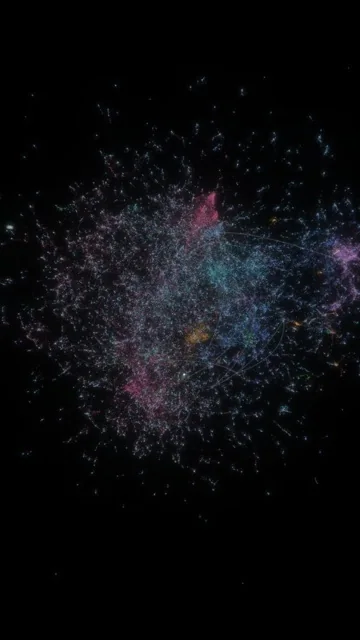
The same prompt through a 27-billion-parameter model.
Same question, a mind sixteen times bigger. This model cuts words differently: Colosseum is now three pieces, Col, osse and um, and the whole prompt is fourteen. Each model learns its own way to cut up text. Each piece becomes a longer list, 5,120 numbers, and threads link it to its nearest neighbors in meaning. Turn on the Words control and you can see the map group one city across languages: Rome sits beside Roma, 罗马 and Рим.
Tokenizers learn their pieces from the text they are trained on, merging the most frequent pairs of characters into larger units, so two models trained differently end up with different pieces for the same word [1]. This one knows 248,044 tokens, against 151,643 for the small model. Its map, like the first, is a three-dimensional picture of lists that really have thousands of dimensions, and the threads join each piece to the six pieces closest to it in the full space. Words that are used alike land close together [2], and in this model that holds even across languages for Rome.
Chapter II Down 64 layers Free
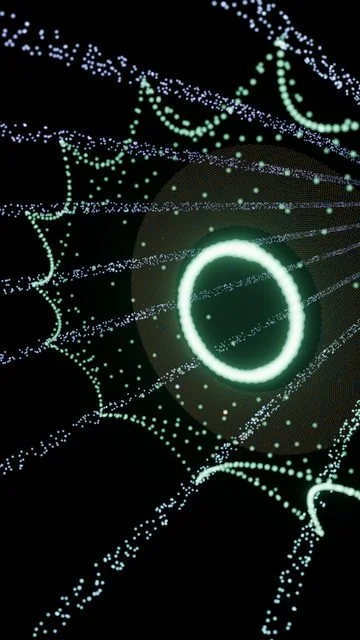
64 layers: 16 of attention and 48 of running memory.
This river is longer: 64 layers deep. Blue gates are attention; green gates are a running memory. In layer four a familiar head copies the pattern, the same tool the small model grew on its own. Most layers here have no attention at all. Instead, each word writes into a memory that later words read, and only every fourth layer looks back with attention. Two kinds of layer, one stream of thought.
This model is a hybrid: 16 attention layers and 48 memory layers. The two kinds are close cousins: a form of attention can be run as a memory updated word by word, which makes reading long texts far faster [3], and a memory layer can likewise be unrolled into word-to-word weights. That is how the Story draws the memory layers like the attention ones, rewriting each exactly as how much each word draws on each earlier word. The familiar head in layer four is an induction head, which spots an earlier pattern, A followed by B, and predicts B when A returns; researchers argue such heads may drive much of how models of any size learn from their prompts [4].
Chapter III The logit lens Plus
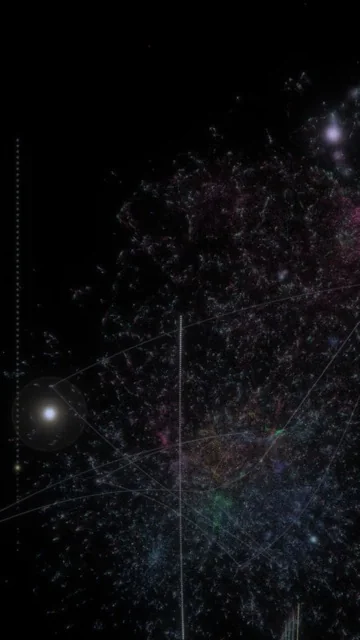
The bigger model reads as noise for about 50 layers, then says Rome at layer 57.
Ask the big model for its guess at every layer. For about fifty layers, all you can read is noise. That does not mean nothing is happening; its early work is in a form this lens cannot read. Keep climbing: the ladder has 65 rungs. By layer forty the word Roman is already among its guesses. Near the top its best guess is a Chinese word meaning "which", as if it were asking itself the question. Then, at layer 57: Rome, with no detour through Germany.
The logit lens reads each layer by borrowing the model's last step, which was trained only on the final layer, so it can miss what earlier layers hold. It is often brittle, and a trained version, the tuned lens, reads layers more reliably [5]. The Chinese word has a cousin in research: tracing the guesses of multilingual models layer by layer, one team found their middle layers favor English versions of words even when the prompt is in another language [6]. The language of a model's in-between guesses need not be the language of its answer.
Chapter IV The choice Plus
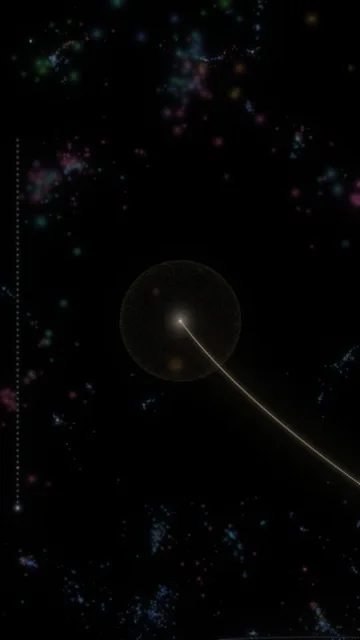
The model scores all 248,044 tokens, and Rome gets 92 %.
Every star is a word this bigger model knows, nearly a quarter of a million of them. Rome wins again, with 92 percent. Italy and "which" are the runners-up. It is a little less sure than the small model, which gave Rome 97.4 percent. Bigger is not always bolder.
A larger model isn't automatically more confident; this one simply spreads a little more of its probability over close alternatives, the country and the question word. The way the next word is chosen is the same as before: the scores become probabilities, and with greedy decoding the program running the model takes the top token every time [7]. So the two models, built differently, give the same answer to this question. The next one separates them.
Chapter V Two hops Plus
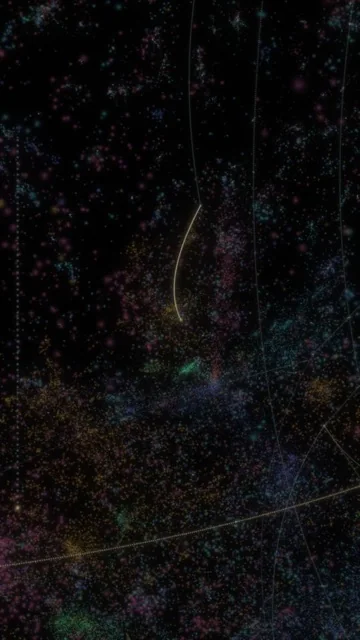
A two-hop question: the 27B finds Dijon, the 1.7B takes the shortcut to Paris.
Now a harder question, with a hidden step: "The engineer the Eiffel Tower is named after was born in the French city of". To answer, you must first think of a name, Gustave Eiffel, and nobody tells the model to take that step. Asked the same thing, the small model just says Paris. Watch the cloud cross the map as the big model works. At layer 61 it seems to name him: Gust. At the last layer comes the right answer, Dijon.
Gustave Eiffel was born in 1832 and grew up in Dijon [8]. Questions like this are called two-hop, or multi-hop: the model has to find a bridge, here the engineer, without writing it down, then answer a second question about it. Studies find models often do resolve the bridge internally, more reliably as they grow larger [9], and that when they fail, the second hop can start too late in the layers to be finished [10]. Here the big model gives Dijon 44 percent at its last layer. The flash of Gust at layer 61 is a reading through the lens, an interpretation, which is why the narration says it "seems" to name him.
Chapter VI Small mind, big mind Plus
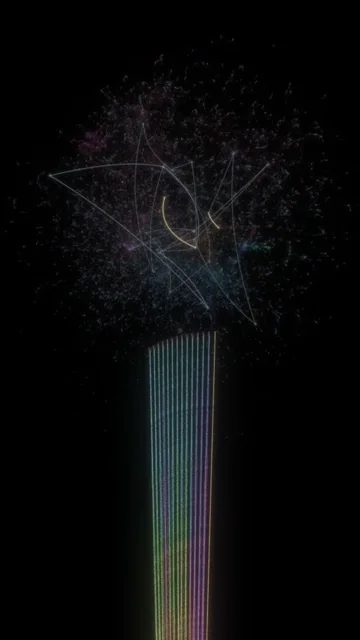
Both models find Rome; only the bigger one finds the hidden step to Dijon.
Here is the whole 27-billion-parameter model, all at once: more than a million neurons, and a thought climbing 64 layers, sixteen of attention and 48 of memory. The comet follows its guesses across the map to Rome. Both models find Rome. Only this one finds the hidden step to Dijon. This one had room for one more step.
The big model has more than twice as many layers as the small one and about 16 times as many parameters. Research supports a careful version of what the two Stories show: in one large study, the ability to take the hidden first hop grew clearly with model size, while making use of it for the second hop did not [9]. These Stories compare two models on a few prompts, so they show what happened here, not a law about size.
What’s simulated, and what isn’t
As in the first Story, the numbers are measured from a real model running these prompts: its token pieces, which earlier words each word draws on, its guess at every layer, its final probabilities and its answer to the two-hop question. What is drawn for you is the space they live in. The map of meaning is a three-dimensional picture of lists that really have 5,120 numbers each, and its threads link each piece to its six nearest neighbors in the full space. The memory layers have no attention of their own, so to draw them the same way each is rewritten exactly as how much each word draws on each earlier word. The logit lens reads early layers poorly, so the noise of the first fifty layers is a limit of the lens, not of the model, and the flash of Gust at layer 61 is an interpretation.
Watch Anatomy of a Thought II in Everdust
Anatomy of a Thought II is in the Everdust app on iPhone and iPad, Android, Apple Vision Pro, Mac, Apple TV and Meta Quest 3 and 3S. Open Everdust, choose Stories, then Anatomy of a Thought II. Free: chapters I–II. Everdust Plus: chapters III–VI.
Everdust on the App Store (iPhone, iPad, Apple Vision Pro, Mac, Apple TV)Everdust on Google Play (Android)Everdust on the Meta Horizon Store (Quest 3 and 3S)
Everdust is free to download, with no ads and no account. Everdust Plus, an optional subscription, opens every chapter of every Story on iPhone, iPad, Android, Apple Vision Pro, Mac and Apple TV (on Meta Quest, which chapters are free can differ).
Questions people ask
What is multi-hop reasoning in a language model? Answering a question that needs a hidden middle step, such as working out which engineer the Eiffel Tower is named after before saying where he was born. Studies find models often take that first hop internally, more reliably as they grow larger [9].
Do bigger language models reason better? Sometimes. Here only the 27-billion-parameter model gets the two-hop question right, and research finds the hidden first step grows more reliable with size, though using it for the second step doesn't clearly improve [9].
What is an induction head? An attention head that spots a pattern seen earlier, A followed by B, and predicts B when A comes up again. Researchers argue such heads may drive much of a model's ability to learn from its prompt [4].
What is a hybrid language model? One that mixes attention layers with other kinds, such as layers that keep a running memory updated word by word. A form of attention can itself be run as that kind of memory [3]. The model in this Story uses attention in only every fourth layer.
Sources
- Sennrich, R., Haddow, B. & Birch, A. (2016). Neural machine translation of rare words with subword units. Proceedings of the 54th Annual Meeting of the Association for Computational Linguistics, 1715.
- Mikolov, T., Chen, K., Corrado, G. & Dean, J. (2013). Efficient estimation of word representations in vector space. arXiv:1301.3781.
- Katharopoulos, A., Vyas, A., Pappas, N. & Fleuret, F. (2020). Transformers are RNNs: fast autoregressive transformers with linear attention. Proceedings of the 37th International Conference on Machine Learning, PMLR 119.
- Olsson, C. et al. (2022). In-context learning and induction heads. arXiv:2209.11895.
- Belrose, N. et al. (2023). Eliciting latent predictions from transformers with the tuned lens. arXiv:2303.08112.
- Wendler, C., Veselovsky, V., Monea, G. & West, R. (2024). Do Llamas work in English? On the latent language of multilingual transformers. Proceedings of the 62nd Annual Meeting of the Association for Computational Linguistics, 15366.
- Holtzman, A., Buys, J., Du, L., Forbes, M. & Choi, Y. (2020). The curious case of neural text degeneration. International Conference on Learning Representations; arXiv:1904.09751.
- American Society of Civil Engineers. Alexandre Gustave Eiffel (Notable Civil Engineers).
- Yang, S. et al. (2024). Do large language models latently perform multi-hop reasoning? Proceedings of the 62nd Annual Meeting of the Association for Computational Linguistics, 10210.
- Biran, E. et al. (2024). Hopping too late: exploring the limitations of large language models on multi-hop queries. Proceedings of the 2024 Conference on Empirical Methods in Natural Language Processing, 14113.
Chapter stills: Everdust, from each chapter’s live simulation. The Story’s script was written for Everdust from the sources above; River reads it. This page retells it in its own words.